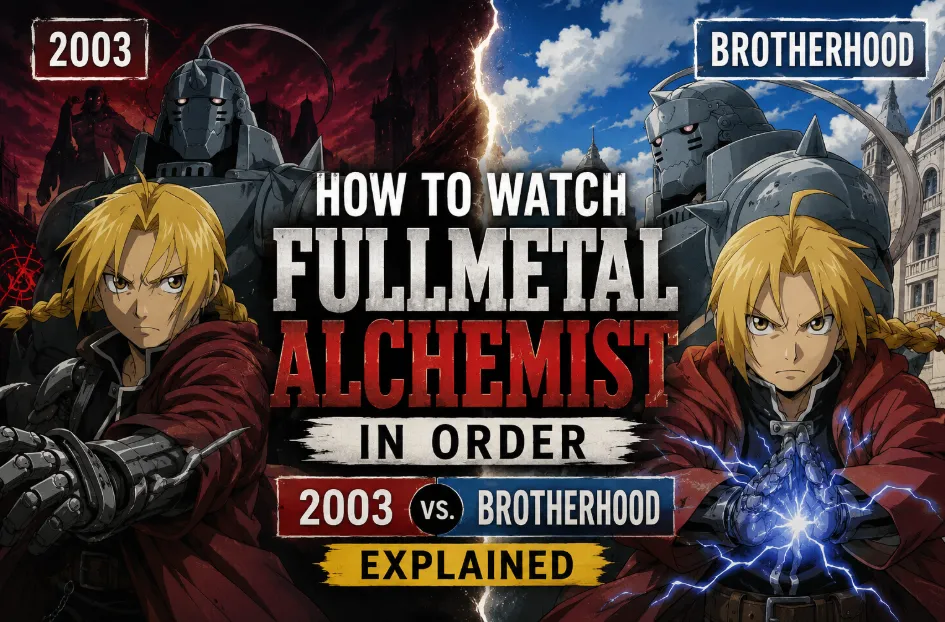
In the world of anime, few titles command as much reverence as Fullmetal Alchemist. It is a story of brotherhood, sacrifice, and the haunting consequences of playing God, centered around the law of Equivalent Exchange: "To obtain something, something of equal value must be lost." But for newcomers in 2026, it presents a unique challenge: two different versions of the same story. The 2003 series is a dark, philosophical drama that eventually forged its own original path, while Fullmetal Alchemist: Brotherhood (2009) is the epic, faithful adaptation of the complete manga. Should you watch the original first? Can you skip straight to Brotherhood? And where do the movies and OVAs fit into the timeline? Whether you are a veteran looking to revisit the Elric brothers or a total novice ready to perform your first transmutation, this guide will break down the differences, the watch orders, and the best way to experience this masterpiece in 2026.
2003 vs. Brotherhood: The Key Differences
While both series begin with the same premise, they quickly diverge into two completely different experiences. Here is how they compare:
| Feature | Fullmetal Alchemist (2003) | FMA: Brotherhood (2009) |
| Story Source | Diverges into an original plot | Faithful to the original manga |
| Pacing | Slow & Detailed (focuses on the start) | Fast-paced (skims the beginning) |
| Tone | Dark, Melancholic, Philosophical | Epic, Action-packed, Heroic |
| World-building | Focuses on the Elric brothers' drama | Expands to global politics and new countries |
| Villains | Different origins/motives for Homunculi | Follows the manga's "Father" storyline |
| Ending | Open-ended (requires the movie) | Definitive and highly satisfying |
Which one should you choose?
-
Choose 2003 if: You prefer a gritty, character-heavy drama and don't mind an ending that deviates from the author's original vision.
-
Choose Brotherhood if: You want the complete, intended story with higher-budget animation and a grand, epic scale.
The Complete Alchemist’s Library: TV, Movies, and OVAs
To experience the full story of Fullmetal Alchemist, you must treat the 2003 original and the 2009 Brotherhood as two separate universes. Mixing them up will lead to massive plot confusion, so use these tables to stay on track.
The 2003 Timeline (Anime-Original Path)
This version is famous for its emotional depth and original ending. You must watch the movie to see how the story truly ends.
| Type | Title | Release | Eps/Length | Key Highlights |
| TV | Fullmetal Alchemist | 2003 | 51 Eps | Intense character drama; focuses on the early tragedies with a dark, philosophical twist. |
| Movie | The Conqueror of Shamballa | 2005 | 105 Mins | The True Finale. Directly picks up from the TV show’s cliffhanger ending. |
| OVA | Premium Collection | 2006 | 4 Shorts | A farewell set containing action, meta-comedy, and a moving epilogue. |
What’s in the Premium Collection?
Though often grouped together, this collection contains four distinct segments:
-
State Alchemists vs. Seven Homunculi: A high-budget, 10-minute "dream match" battle between the military and the sins.
-
Live-Action Short: A surreal meta-short where a chibi-style Edward Elric wanders into the real-world Studio Bones office in Tokyo.
-
The Chibi Party: A hilarious "wrap party" where the entire cast—including the villains—celebrates the end of the 2005 movie.
-
Kids (The Must-Watch): A poignant 3-minute scene set in modern-day 2005 Japan. It follows the Elric brothers' descendants and provides the final emotional closure for the 2003 series.
The Brotherhood Timeline (Manga-Canon Path)
This is the definitive adaptation of the original manga. While the TV series is a complete story, the OVAs provide rich backstory for fan-favorite characters.
| Type | Title | Release | Eps/Length | Key Highlights |
| TV | FMA: Brotherhood | 2009 | 64 Eps | The masterpiece. Epic world-building, fluid action, and a perfect conclusion. |
| Movie | The Sacred Star of Milos | 2011 | 110 Mins | A standalone side-story; best watched after you reach Episode 20. |
| OVA | Brotherhood Specials | 2009-2010 | 4 Eps | Character-focused shorts that expand on the history of the main cast. |
What’s in the Brotherhood Specials?
There are four essential side stories in this timeline:
-
The Blind Alchemist: A haunting tale about a man who allegedly succeeded in human transmutation.
-
Simple People: A heartwarming look at why Winry Rockbell and Riza Hawkeye chose their iconic looks.
-
The Tale of Teacher: The brutal origin story of Izumi Curtis and her survival training on Mt. Briggs.
-
Yet Another Man's Battlefield: A deep dive into the bond between Roy Mustang and Maes Hughes during their military academy days.
The Ultimate Watch Order: How to Experience FMA in 2026
There is no "wrong" way to watch this franchise, but your choice will change how you feel about the characters. Here are the three best paths:
Option A: The "Perfectionist" Order (Release Order)
-
FMA 2003 (Episodes 1–51). Experience the slow-burn character development.
-
Conqueror of Shamballa (Movie). The essential conclusion to the 2003 story.
-
Premium Collection (OVA). Watch for the "Kids" short—the final emotional goodbye.
-
FMA: Brotherhood (Episodes 1–64). Start the "true" manga journey.
-
Brotherhood Specials (OVA). Deepen your love for the cast after the finale.
-
The Sacred Star of Milos (Movie). One last "side-quest" adventure.
Why this is the Gold Standard: This is how the franchise was meant to be experienced. The 2003 version spends much more time on the early chapters, making you fall in love with the characters before the tragedies hit.
The Experience: You start with a dark, philosophical character study (2003) and end with the high-stakes, grand-scale masterpiece (Brotherhood). It feels like visiting two parallel lives of the same brothers.
Option B: The "Manga Purist" Order (The Fast Track)
-
FMA: Brotherhood (Episodes 1–64). The definitive, epic story.
-
Brotherhood Specials (OVA). Essential backstories (Teacher’s training, Mustang’s past).
-
The Sacred Star of Milos (Movie). Optional standalone adventure.
Why this works: If you only have time for one series, this is it. It is the complete, definitive story as written by the original creator, Hiromu Arakawa.
The Experience: High-speed, high-stakes, and consistent. While the beginning feels a bit rushed (since the studio assumed you'd seen the 2003 version), the final 40 episodes are widely considered the greatest run in anime history.
Option C: The "Early Emotional" Hybrid (The Expert Choice)
-
FMA 2003 (Episodes 1–25). Watch until the emotional peak of the Hughes/Nina arcs.
-
FMA: Brotherhood (Restart from Episode 1). Even if it feels repetitive, restarting allows you to spot the new "lore" and "Father" foreshadowing that 2003 lacks.
-
Brotherhood Specials (OVA).
-
The Sacred Star of Milos (Movie).
Why this works: It delivers the strongest emotional impact for the early tragedies while ensuring you get the grand finale of the manga. The 2003 pacing for the "prologue" is simply superior.
Warning: This can be confusing! Certain characters (like the Homunculi) have different origins in each version. Only choose this if you are prepared for some "multiverse" mental gymnastics.
Which one should you choose?
Pick A if you want the full history and don't mind the 100+ episode commitment.
Pick B if you want the most polished, canon-accurate experience.
Pick C if you want the early episodes to hurt as much as possible.
The Efficiency Guide: What to Skip?
In the era of binge-watching, pacing is everything. While Fullmetal Alchemist is famously lean, there are a few moments where the story drags. Here is how to trim the fat without losing the soul of the journey.
1. Fullmetal Alchemist (2003): Filtering the Originality
The 2003 series was produced while the manga was still ongoing, leading to several "filler" episodes that don't contribute to the core mystery of the Philosopher’s Stone.
-
Episode 4 ("The Alchemist's Distress"): A textbook filler episode. It follows a standalone conflict with a corrupt alchemist that is never mentioned again. Safe to skip.
-
Episode 10 ("The Phantom Thief"): A comedic "cat-and-mouse" heist story. While charming, it feels tonally inconsistent with the dark path the brothers are on. Safe to skip.
-
Episode 37 ("The Alchemist to Whom Honor is Due"): This is a controversial skip. While it offers minor character beats for the military cast, it is an original side-story placed right as the main plot is hitting its climax. If you want to keep the tension high, skip this and stay focused on the endgame.
2. In Fullmetal Alchemist: Brotherhood
Brotherhood is very lean, but it has two specific episodes you can ignore:
-
Episode 1 ("Fullmetal Alchemist"): This was created as a "re-introduction" for fans who had already seen the 2003 version. It introduces many characters at once and can actually be a bit confusing for total newcomers. It is optional.
-
Episode 27 ("Interlude"): This is a Recap Episode. It summarizes the events of the first 26 episodes. In the age of streaming, you can 100% skip this and move straight to Episode 28.
3. The Movies & OVAs: Optional or Essential?
-
Conqueror of Shamballa (2005): DO NOT SKIP if you watched the 2003 series. It is the ending.
-
The Sacred Star of Milos (2011): SKIPABLE. It’s a high-budget side story that doesn't impact the Brotherhood ending. Watch it only if you want more "extra credit" content.
-
Premium Collection & Specials: OPTIONAL. These are for fans who want to spend more time with the characters. (Though we still highly recommend the "Kids" short from the 2003 collection).
4. The Golden Rule of the "Parallel Watch"
If you are coming from the 2003 version and transitioning to Brotherhood, you might be tempted to skip the first dozen episodes because the story beats (Nina, Hughes, etc.) feel familiar.
DO NOT DO THIS.
Even though the plot points look the same, Brotherhood plants essential seeds for its unique ending in those early episodes. The origins of the Homunculi, the history of "Father," and the rules of the world are fundamentally different. You can watch them at 1.5x speed if you must, but do not skip them entirely, or you will face a "logic gap" in the final acts.
Where to Watch Fullmetal Alchemist?
In 2026, the licensing for the Fullmetal Alchemist franchise is split between two distinct paths. While Brotherhood remains a streaming staple, the original 2003 series has become a "digital relic" that often requires a direct purchase.
Official Streaming & Purchase Guide
| Category | Content Included | Recommended Platforms | Notes |
| The Manga Path (FA) | FMA: Brotherhood (Full 64 Eps) | Netflix, Hulu, Disney+, Crunchyroll | The most accessible version. It is a flagship title on almost every major anime platform. |
| The Original Path (03) | FMA 2003 (Full 51 Eps) | Apple TV (Purchase/Rent) | Rarely available on subscription-based streaming. Apple TV remains the most stable digital "last stand" for this series. |
| The Movies | Conqueror of Shamballa; Sacred Star of Milos | Apple TV | Usually available for digital rental or purchase. Shamballa is the essential finale to the 2003 storyline. |
| OVAs & Specials | Brotherhood 4 OVAs; 2003 Premium Collection | Amazon | These are rare gems. Physical media is often the only legal way to secure the full high-definition collection. |
Binge-Watching Essentials
The 2003 "Vanishing Act": The 2003 series frequently disappears from streaming due to expired licenses. If you plan to watch this version, we strongly recommend a digital purchase on Apple TV or owning the physical Blu-ray. This is the only way to ensure the story isn't "transmuted" (delisted) out of your library mid-watch.
The Bootleg Trap: Because the 2003 Blu-rays have been out of print (OOP) for years, secondary markets like eBay are flooded with high-quality fakes. If you’re buying physical, check the back of the discs—authentic Blu-rays are silver/blue, while most bootlegs have a dark grey or black underside.
Audio Warning: Be aware that some platforms (especially older digital copies) may only host the English Dub or the Subtitled version separately. Before you hit "Purchase" on Apple TV or Amazon, double-check that your preferred audio track is included in that specific bundle.
FAQ: Common Alchemy Questions
1. Do I have to watch FMA (2003) before Brotherhood?
No. They are independent stories. However, we recommend starting with 2003 if you want a slower, more emotional introduction to the characters. If you only want the "true" manga ending and high-octane action, go straight to Brotherhood.
2. Is Brotherhood a remake or a sequel?
It’s a faithful adaptation, not a sequel. Brotherhood follows the original manga storyline from start to finish. The 2003 series, meanwhile, branched off into an anime-original story because the manga was still being written at the time. Think of them as two different paths starting from the same beginning.
3. Why do the villains (Homunculi) have different identities?
It’s due to the different "lore" of each series. In 2003, Homunculi are the tragic failed results of human transmutation (making them more personal to the cast). In Brotherhood, they are the seven deadly sins created by the main antagonist. This is why characters like Wrath and Sloth are entirely different people depending on which show you watch.、
4. Are the movies essential? Will I miss the main plot if I skip them?
For 2003 Viewers: YES. You must watch Conqueror of Shamballa. Without it, your story ends on a massive cliffhanger at Episode 51. The movie is the true series finale.
For Brotherhood Viewers: NO. The Sacred Star of Milos is a standalone side story (Gaiden). While the animation is high-quality, skipping it will not affect your understanding of the main plot at all.
5. Does Fullmetal Alchemist have "filler" episodes?
Almost none. Unlike other long-running shonen anime (like Naruto or One Piece), Fullmetal Alchemist is incredibly lean.
-
Brotherhood is especially fast-paced, following the manga almost page-for-page.
-
The 2003 version has some "anime-original" episodes (as discussed in our skip guide), but even those are designed to build the world rather than just waste time. This is why FMA remains the gold standard for a "perfect binge-watch."
6. What is the "True" ending of the franchise?
The "True" ending—as intended by the author Hiromu Arakawa—is Episode 64 of Brotherhood. The 2003 series has its own unique ending, which is only concluded in the movie Conqueror of Shamballa.
7. Is there any "New" Fullmetal Alchemist content in 2026?
While the Elric brothers' story is complete, 2026 marks the 25th Anniversary of the manga. Keep an eye out for Hiromu Arakawa's latest anime, Daemons of the Shadow Realm (Yomi no Tsugai), which many fans consider the spiritual successor to FMA's legacy.
Final Summary: The Alchemist’s Choice
To wrap up your journey in 2026, keep these three final points in mind:
-
The Best Path: Watch Fullmetal Alchemist: Brotherhood for the definitive, manga-accurate epic. If you want maximum emotional depth, watch the 2003 series first.
-
The Golden Rule: Never skip the Conqueror of Shamballa movie if you watch 2003, and never skip the early episodes of Brotherhood just because they feel familiar.
-
The 2026 Reality: Since 2003 licensing is unstable, buy it digitally (Apple TV) or own the Blu-ray to ensure your collection never disappears.
The Law of Equivalent Exchange is simple: the more time you invest in the Elric brothers' story, the more it will give back to you in inspiration and emotion.
"A heart made fullmetal is never easily broken."