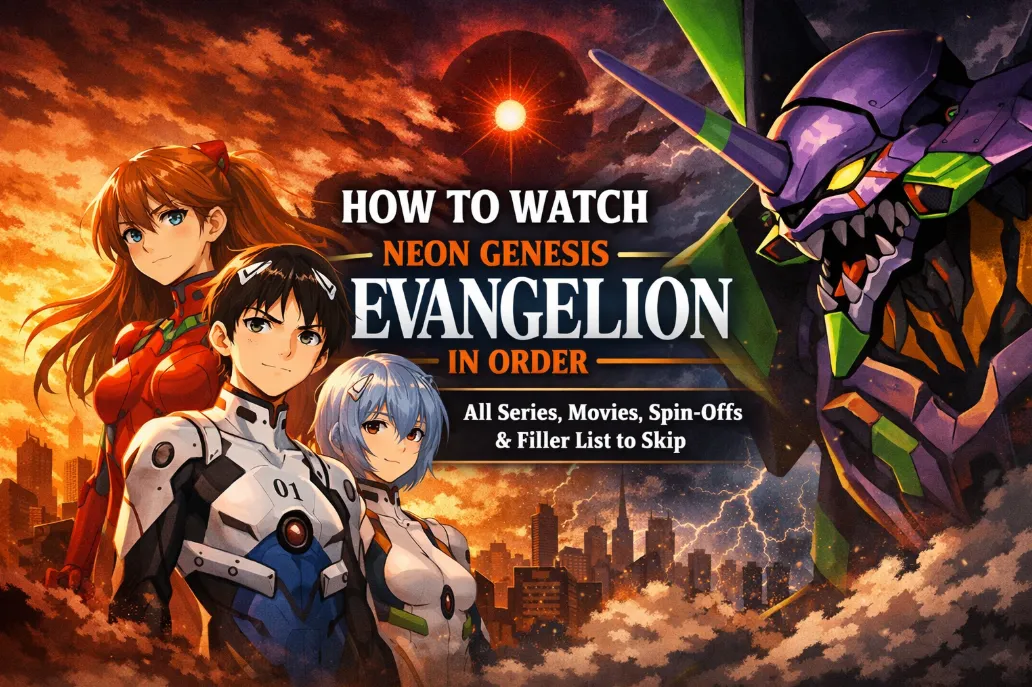
Few anime franchises carry as much weight—or as much confusion—as Neon Genesis Evangelion. What began in 1995 as a deconstruction of the "Director’s Cuts" genre quickly evolved into a profound psychological study of trauma, loneliness, and the human condition. For over three decades, it has remained an enigma—a masterpiece that is as famous for its world-changing impact as it is for its notoriously complex watch order. As we celebrate the 30th Anniversary in 2026, the "Evangelion Universe" is more expansive than ever. With the recent release of the 30th Anniversary Special Screening (the Asuka-centric short film) and the definitive 3.0+1.11 UHD editions, navigating this franchise can feel like deciphering the Dead Sea Scrolls. Should you start with the grainy 90s cel-animation or the high-octane 21st-century Rebuilds? Is the TV ending "the real one," or is the movie the only truth? This 2026 comprehensive guide is designed to be your "Human Instrumentality Project" for the series. We will break down the essential paths, identify the critical "plot patches" hidden in short films, and provide a strict filler list so you can experience this legendary saga exactly how Hideaki Anno intended.
The World of Evangelion: An Overview (1995–2026)
Created by Hideaki Anno and produced by Studio GAINAX (later Studio Khara), Neon Genesis Evangelion is a landmark in science fiction. Set in a post-apocalyptic world following a global cataclysm known as "Second Impact," the story follows Shinji Ikari, a 14-year-old boy summoned by his estranged father to pilot a giant bio-machine called an Evangelion (EVA).
Shinji and his fellow pilots—the enigmatic Rei Ayanami and the fiery Asuka Langley—must defend the fortress city of Tokyo-3 against monstrous beings known as Angels. However, beneath the surface-level mecha battles lies a deep exploration of philosophy, religious symbolism, and the "Human Instrumentality Project."
To understand the 30-year evolution of the franchise, the official works are categorized into four primary pillars:
-
The Core TV Origin (1995): The foundation of the characters and the mystery.
-
The Classic Cinematic Conclusion (1997): The visceral, high-stakes ending to the original run.
-
The Rebuild Tetralogy (2007–2021): A high-budget reimagining that diverges into a new timeline.
-
The 30th Anniversary Era (2022–2026): Critical "plot patches" and the final 2026 farewell.
I. The Essential Core: The Two Eras of EVA
Most fans recommend completing the Legacy Saga first to build an emotional connection before moving on to the modern Rebuild Saga.
Phase 1: The "Legacy" Saga (The 90s Original)
This era defines the "Evangelion Phenomenon." It is gritty, philosophical, and essential for understanding the series' DNA.
| Title | Release | Format | Essential Status | 2026 Pro-Tip |
| Neon Genesis Evangelion | 1995 | TV (26 Eps) | MANDATORY | Features the Director's Cut for Eps 21–24. |
| The End of Evangelion (EoE) | 1997 | Movie | MANDATORY | The "true" cinematic ending. Do not skip. |
| DEATH (TRUE)² | 1998 | Recap | OPTIONAL | A stylish 60-minute refresher of the TV series. |
| Death & Rebirth | 1997 | Hybrid | SKIP | A placeholder version. Redundant in 2026. |
Phase 2: The "Rebuild" Saga (The Modern Tetralogy)
These films feature modern animation and eventually shatter the original timeline to tell a new story of growth and closure.
| Title | Release | Role | Essential Status | 2026 Pro-Tip |
| Evangelion: 1.11 You Are (Not) Alone | 2007 | Part 1 | MANDATORY | High-def remake of the first 6 TV episodes. |
| Evangelion: 2.22 You Can (Not) Advance | 2009 | Part 2 | MANDATORY | The plot begins to diverge significantly here. |
| Evangelion: 3.33 You Can (Not) Redo | 2012 | Part 3 | MANDATORY | A dark shift into a broken, future world. |
| Evangelion: 3.0+1.11 Thrice Upon a Time | 2021 | Final | MANDATORY | The grand finale. Seek the 3.11 UHD edition. |
I. 2026 New Releases & Essential Shorts
These "Plot Patches" are critical for bridging the narrative gaps within the Rebuild timeline.
| Title | Release | Type | Why Watch? |
| Evangelion: 30+ | 2026 | 30th Anniversary | The ultimate "curtain call" and farewell to fans. |
| 3.0 (-46h / -120min) | 2023 | Prequel Shorts | Essential backstory explaining the 14-year gap. |
| until You come to me. | 2014 | Visual Essay | An emotional bridge setting the mood for the finale. |
III. The "Deep Cuts": Experiments & Parodies
For completionists who want to explore EVA’s influence on visual art and comedy.
| Title | Release | Style | Role in 2026 |
| Another Impact | 2015 | 3D-CG | A gritty visual feast showing a realistic "Unit Null." |
| Petit Eva (Puchi Eva) | 2007 | Chibi Comedy | The official "stress-relief" parody. No dialogue. |
| Shinkalion Crossover | 2018 | Action | A fun kids' crossover where Unit-01 is a train. |
Neon Genesis Evangelion Recommended Watch Orders
Depending on your time and interest level, there are three primary ways to experience the Evangelion multiverse.
🏆 Route A: The "Emotional Evolution" Path (Recommended for 90% of Viewers)
This is the most rewarding way to experience the 30-year journey. You feel the grit of the 90s followed by the visual redemption of the 2020s.
-
Step 1: The Original Series (Eps 1–26) – The foundational experience.
-
Step 2: The End of Evangelion – The visceral, cinematic climax of the 90s era.
-
Step 3: The Rebuild Tetralogy (1.11 → 2.22 → 3.33 → 3.0+1.11) – Experience the high-budget reimagining and the ultimate resolution.
-
Step 4: 🏁 EVANGELION: 30+ (2026 Special) – The final meta-farewell to the characters.
🧠 Route B: The "Lore-Complete" Path (For Completionists)
This path uses the official "Plot Patches" to bridge narrative gaps, specifically filling the confusing 14-year time jump between the second and third Rebuild movies.
-
Phase I: The Classic Cycle
-
TV Series (Eps 1–26) + The End of Evangelion.
-
-
Phase II: The Rebuild Divergence
-
Evangelion: 1.11 & 2.22.
-
-
Phase III: The "Lost 14 Years" (Critical Plot Patches)
-
3.0 (-120min): View this to understand the mood before the US Operation.
-
3.0 (-46h): Essential. Explains the hostility of the WILLE crew.
-
-
Phase IV: The Final Descent
-
Evangelion: 3.33 → until You come to me. (Emotional transition).
-
Evangelion: 3.0+1.11 (The 2.5-hour epic conclusion).
-
-
Phase V: The Epilogue
-
🏁 EVANGELION: 30+.
-
⚡ Route C: The "Modern Cinematic" Path (The Fast Track)
Best for viewers who only want modern, high-definition animation and a more straightforward (yet still emotional) narrative.
-
Step 1: The Rebuild Tetralogy (1.11 $\rightarrow$ 2.22 $\rightarrow$ 3.33 $\rightarrow$ 3.0+1.11).
-
Step 2: The Prequel Shorts ((-120min) & (-46h)) – To understand the lore you missed.
-
Step 3: 🏁 EVANGELION: 30+.
⚠️2026 Pro-Tips: Avoiding the "Mind-Loop"
1. The Version Numbers
Never settle for 1.0 or 3.0. In the EVA world, decimal points matter. Always seek out .11, .22, .33, and 3.0+1.11 for the best lighting, animation, and additional scenes.
2. The "Therapy" Timings
If you feel "hollow" or depressed after watching The End of Evangelion or Rebuild 3.33, immediately watch a few episodes of Petit Eva. It is the official "stress-relief" designed to remind you that these characters can be happy.
3. The "3.0+1.11" Advantage
While streaming platforms often host the 3.0+1.01 version, the 3.0+1.11 physical releases (including the 2026 30th Anniversary editions) are superior as they bundle the prequel shorts directly as bonus features, making the narrative transition far more coherent.
The Official Filler List: What to Skip in 2026?
Evangelion has a long history of "Recap" movies created due to production delays or marketing requirements. To avoid watching the same footage three times, follow this "Skip List."
🚫 The "Zero-Value" Redundancy List
If you skip these, you lose 0% of the story. These are purely for marketing or technical display.
-
The Recap "Trap" (Death & Rebirth / DEATH (TRUE)²): In the 90s, these were the only way to catch up. In 2026, they are redundant. Death is just a super-cut of the show you just watched, and Rebirth is a literal "trailer" for the ending. Unless you are an editor studying montage techniques, your time is better spent elsewhere.
-
The "Mecha-Toy" Crossover (Shinkalion): Seeing Unit-01 transform into a bullet train is fun for a meme, but it exists in a vacuum. It is "EVA-lite" for a younger demographic and has zero tether to the multiverse lore.
-
The CG Technical Demo (Another Impact): A stunning "what-if" scenario in 3D. Watch it on YouTube if you love mechanical design, but don't look for character development here—there isn't any.
⚠️ The "Vibe-Check" Skips (For the Impatient)
Watch these only if you are in the mood for art, not just information.
-
The "Clip Show" (TV Episode 14, first 11 mins): If you are binge-watching the series in one weekend, you don't need a 10-minute recap of what you saw two hours ago. Fast-forward to the 11-minute mark to skip Rei’s monologue and get straight to the NERV secret trials.
-
The Silent Poem (until You come to me.): This is an "atmospheric bridge." It provides zero dialogue and zero new plot points. It’s a beautiful emotional palette cleanser, but if you're hungry for "what happens next," you can move straight to the finale.
🛑 THE NON-NEGOTIABLES: Do Not Skip
Newcomers often mistake these for filler because they look different. They are NOT.
-
TV 25 & 26 (The Psychological Ending): Many guides tell you to skip these because of the "budget" animation. That is a mistake. These episodes are the philosophical heart of the franchise. While End of Evangelion shows you the physical apocalypse, these episodes show you the mental one. You need both.
-
The 3.0 Plot Patches (-120min & -46h): In 2026, these are no longer "optional bonuses." They are essential narrative tissue. If you skip them, the 14-year time jump in the Rebuilds will feel like a mistake rather than a mystery. These are your "missing link."
To master the EVA timeline efficiently: Delete the 90s recaps, fast-forward the Episode 14 recap, but protect the TV finale and the 3.0 Prequels at all costs. This is the only way to reach the 2026 30+ Special with your emotional intelligence (and sanity) intact.
2026 Global Access Guide: Where to Watch Neon Genesis Evangelion?
In 2026, the licensing for Evangelion is split between two major streaming giants and Studio Khara's own digital archives.
1. The Digital Streaming Map
For most viewers, these two subscriptions will cover the entire main story.
| Platform | Era / Content | Recommended Version | 2026 Pro-Tip |
| Netflix | Classic Era (TV 1–26 + EoE) | 4K HDR Remaster | Includes the Director’s Cut (Eps 21-24). Look for the "Official Dub" for a consistent experience. |
| Amazon Prime | Rebuild Era (1.11 – 3.0+1.01) | 3.0+1.01 | The exclusive home for the movies. Use the X-Ray Trivia feature to track Angel names. |
| Khara YouTube | Anniversary Shorts | Studio Khara Official | The only place to find EVANGELION: 30+ (The 2026 special short) and high-quality trailers. |
2. The "Ultimate Lore" Access (3.0+1.11 & Shorts)
If you want the absolute "Final" visual polish and the missing story links, you'll need to look beyond standard streaming.
| Source | Content | Why this version? | Access Method |
| Physical Media | Evangelion 3.0+1.11 UHD | Best Visuals: Includes hundreds of frame-by-frame improvements over the 1.01 streaming version. | Available as a 4K UHD/Blu-ray set. The standard for home theaters. |
| Bonus Features | The Prequel Shorts (-46h / -120min) | Essential Lore: These bridge the 14-year gap. | Included on the 3.0+1.11 Disc as bonus features. Occasionally streamed on Studio Khara's YouTube during anniversary events. |
| Digital Store | 3.0+1.11 (Rental/Buy) | The Upgrade: A digital version of the refined cut. | Search Apple TV or Google Play. Look specifically for the .11 suffix in the title description. |
Frequently Asked Questions
1. Why can't I find the Rebuild movies on Netflix?
A major licensing split. While Netflix holds the global streaming rights for the original 1995 TV series and The End of Evangelion, the New Movie Tetralogy (1.11 through 3.0+1.01) is exclusively licensed to Amazon Prime Video. If you want to finish the story, you’ll have to switch platforms. In 2026, there are no signs of these movies moving to Netflix, as Amazon helped fund the final film's global distribution.
2. Is the 1995 TV series still "mandatory" now that we have high-def movies?
The Verdict: Absolutely. While the Rebuild movies have 2020s-tier production value, they are conceptually a "response" to the 1995 original. Without witnessing the raw, psychological chaos of the 90s, the "epic liberation" at the end of the final movie loses its soul. You need to see the struggle to appreciate the healing.
3. Is the Rebuild tetralogy a remake, a reboot, or a sequel?
It’s a Multiverse/Time-Loop. The community generally agrees that the Rebuilds are not meant to replace the TV show. Instead:
-
Movies 1 & 2 act as a high-budget reimagining.
-
Movies 3 & 4 shift into a completely original, parallel timeline. Think of it as a separate cycle of reincarnation rather than a simple retelling.
4. Why are TV Episodes 25 & 26 so abstract? Did I miss the actual ending?
You didn't miss it; you're seeing the Mental Ending. In 1996, due to budget and time collapses, director Hideaki Anno finished the story through "Internal Expressionism."
-
TV 25-26: The Internal apocalypse (What’s happening inside Shinji’s mind).
-
The End of Evangelion (EoE): The External apocalypse (What’s happening to the world). They are two sides of the same coin. You need both to get the full picture.
5. Which ending is "Canon"—the 90s version or the 2020s version?
Both are equally valid.
-
The Old Ending (EoE): Explores the pain of Acceptance.
-
The New Ending (3.0+1.11): Explores the joy of Moving On. Watching both allows you to see the growth of the creator, Hideaki Anno, over 30 years. In 2026, we view them as a dual-narrative of human maturity.
6. I can't find the Q Prequels on streaming. How do I bridge the 14-year gap?
The Solution: Look for "Special Features." These shorts are the "connective tissue" between 2.22 and 3.33. Currently, they are exclusive bonus features on the 3.11 UHD/Blu-ray. If you can't buy the disc, check Studio Khara’s YouTube or community archives. They are critical for understanding why the characters are so hostile in the third movie.
7. What is the 2026 "Next Genesis" project, and do I need to finish the old saga first?
It is a "New Cycle" by a new creator—but the classics remain essential.
The 30th Anniversary (Feb 2026) revealed Evangelion: Next Genesis, a historic shift written by Yoko Taro (NieR: Automata) and directed by Kazuya Tsurumaki.
-
The Vibe: Expect Yoko Taro’s signature existential despair and meta-twists. It’s a darker, parallel-world take on the EVA mythos.
-
The Link: It is likely a fresh start, but Taro is known for subverting established lore.
-
The Strategy: Watch the original TV series and movies first. You can't appreciate how Taro "breaks the rules" if you don't know the rules of the EVA world.
2026 Pro-Tip: Watch the Evangelion: 30+ short on YouTube first. It’s the official emotional bridge to this new era.
Final Wrap-Up: Your Action Plan
That’s it. You’re now fully briefed for the 2026 Evangelion experience. Here is the high-speed summary for your final approach:
-
The "Must-Watch" Core: TV Series (Ep 1-26) → End of Evangelion → The 4 Rebuild Movies. That’s the meat and potatoes.
-
The "Brain Fix": If you get to Movie 3 and feel like you missed a season, go watch the p-46h and -120min shorts. They are the "missing links."
-
The "2026 Special": Once you've finished the movies, hit up the 30+ short on YouTube. It’s the perfect palate cleanser before you move on with your life.
-
The "Next Big Thing": Keep an eye on the Yoko Taro project. But seriously, don’t touch it until you’ve seen the originals, or you'll just be confused and depressed.
Evangelion is a mess, just like real life. You’re going to be confused, you’re going to be annoyed, and you’re probably going to want to hug a fictional teenager. That’s the whole point.