The year is 2026, and the global anime phenomenon continues its meteoric rise. With an ever-expanding multiverse of seasonal releases and an explosion of global streaming platforms like Crunchyroll, Netflix, and Disney+, simply "keeping track" has become an art form in itself. Today's anime enthusiasts demand sophisticated digital tools that not only log their viewing habits but also connect them with like-minded fans, offer insightful analytics, and even predict their next obsession. For years, a handful of platforms have dominated this crucial niche: the venerable MyAnimeList, the sleek AniList, the social-first Kitsu, and the hardcore data fortress AniDB. As we delve into 2026, the lines between these platforms have become more nuanced, their feature sets more refined, and their communities more distinct. This comprehensive guide will dissect each of these titans, helping you decide which platform will serve as your ultimate anime companion.
Platform Overview: At a Glance
Before diving into detailed feature comparisons and community analysis, it’s helpful to start with a high-level overview of each platform. While all four services aim to help users track anime and manga, their focus, design philosophy, and target audiences differ significantly. The table below summarizes the core characteristics of MyAnimeList, AniList, Kitsu, and AniDB, offering a quick snapshot of what each platform does best.
| Feature / Platform |
MyAnimeList (MAL) |
AniList |
Kitsu |
AniDB |
| Launch Year | 2004 | 2013 | 2013 (as Hummingbird) | 2002 |
| User Base (Est.) | 15M+ Active | 5M+ Active | 2M+ Active | < 500K (Niche) |
| UI/UX Modernity | Established/Classic | Cutting-edge/Sleek | Social-driven/Modern | Dated/Functional |
| Database Breadth | ★★★★★ (Global) | ★★★★☆ (Global + Webtoons) | ★★★☆☆ (Anime-focused) | ★★★★★ (Hyper-detailed) |
| Community Style | Traditional Forums | Dynamic Social Feeds | Activity Streams | Technical Discussion |
| Mobile Experience | Functional Official App | Superior 3rd Party Apps | Excellent Mobile Web | Minimal Support |
| Best For | The Purist & Ranker | The Modern Customizer | The Social Mobile User | The Hardcore Archivist |
Detailed Platform Breakdown: The Titans of 2026
The overview table provides a quick snapshot of what each platform offers, but numbers and charts only tell part of the story. To truly understand their strengths, weaknesses, and unique characteristics, we need to examine each platform in detail. The following section dives into the Titans of 2026, highlighting what makes each one stand out and where they might fall short for different types of users.
1. MyAnimeList (MAL): The Industry Benchmark
Official Website:https://myanimelist.net/
Launched in 2004, MyAnimeList (MAL) is the most established and widely recognized anime and manga tracking platform. It hosts the largest user base and one of the most comprehensive databases available, making it a central hub for anime fans worldwide. Beyond basic tracking, MAL offers user reviews, ratings, forums, clubs, and seasonal challenges, creating a highly active community ecosystem.
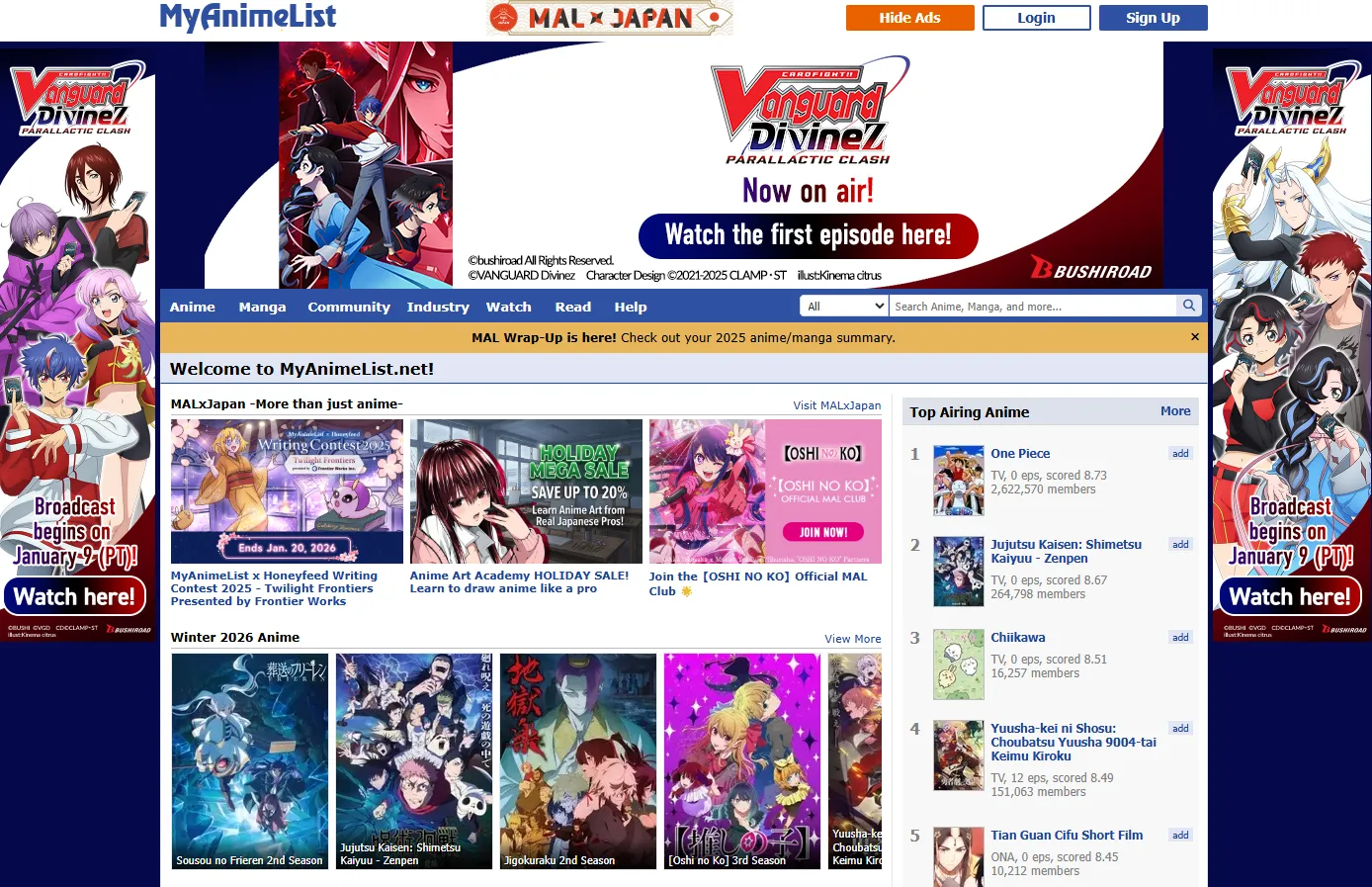
Despite its popularity, MAL’s interface has changed little over the years and can feel dated compared to newer platforms. Some advanced tracking features—such as bulk editing and deeper statistics—are also relatively limited. However, for users who value community discussions, historical reviews, and broad consensus ratings, MAL remains an unmatched resource in 2026, especially with its unparalleled support for third-party extensions like MAL-Sync.
| Pros | Cons |
| Largest Community: Unmatched volume of user reviews, forum discussions, and club activities. | Outdated UI: The interface design remains stuck in the mid-2000s, feeling cluttered and non-intuitive. |
| Industry Authority: MAL scores are globally recognized as the primary benchmark for anime rankings. | Limited Tools: Lacks modern features like advanced data visualization, bulk list editing, and deep statistics. |
| Comprehensive Data: Houses deep historical archives of production staff, studios, and obscure titles. | Rating Wars: Scores are frequently skewed by "review bombing" or coordinated fan group activities. |
| Extension Support: Perfect compatibility with almost all 3rd-party browser tools like MAL-Sync. | Mobile Friction: The official app is functional but lacks the fluid UX found in modern competitors. |
| Seasonal Engagement: Strong tradition of community-wide seasonal challenges and voting events. | Rigid Database: The submission and approval process for new entries can be slow and bureaucratic. |
2. AniList: The Modern Powerhouse
Official Website:https://anilist.co/
If MyAnimeList is the "Wikipedia" of the anime world, AniList is its "Modern OS." Gaining massive traction over the last decade, AniList prioritizes a sleek, ad-free user experience and high customizability. It has become the go-to platform for tech-savvy fans who prefer a minimalist aesthetic and a dynamic social media-style feed. AniList’s greatest strength lies in its flexibility—offering multiple scoring systems and a powerful API that fuels a vast ecosystem of high-quality third-party mobile apps.
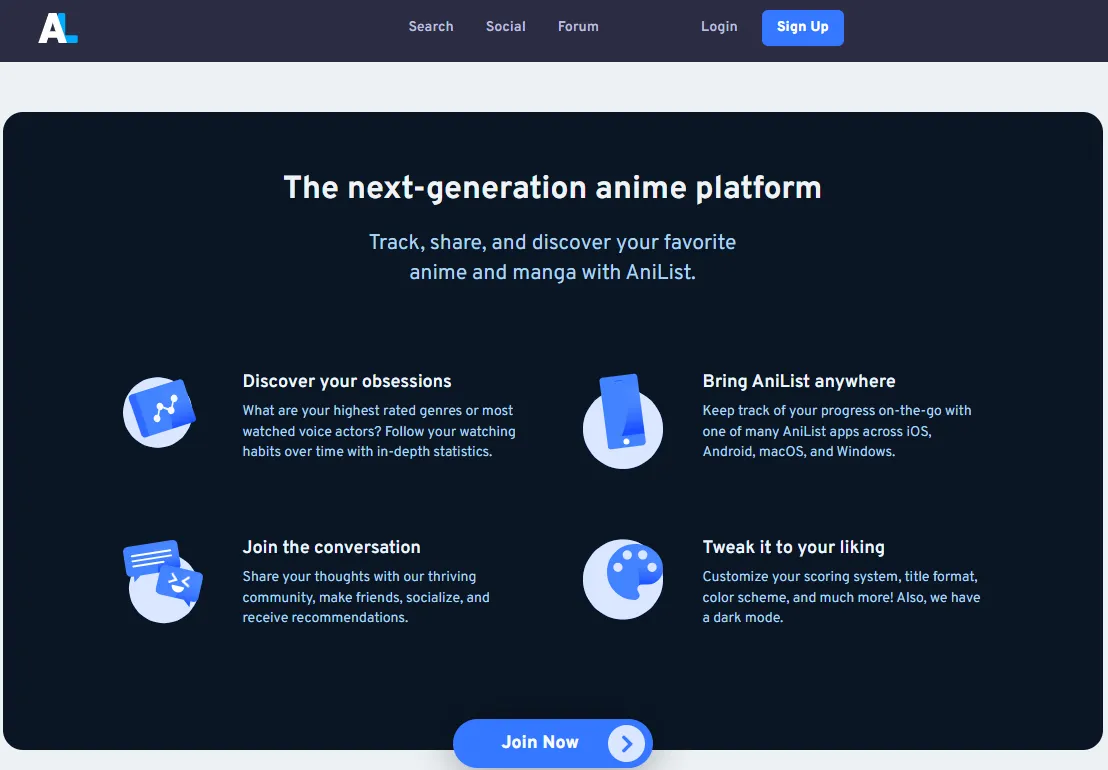
By 2026, AniList has solidified its position as the primary alternative for users who find traditional platforms too restrictive. Its tagging system is far more granular than its competitors, allowing users to filter content by very specific tropes and themes. While it may lack the sheer historical volume of MAL's forum archives, its real-time activity feed creates a sense of immediate connection, making the tracking experience feel more like a social journey than a simple database entry.
| Pros | Cons |
| Modern UX: Features a clean, fast, and completely ad-free interface designed for the 2020s. | Visual Overload: Highly customized user profiles can lead to slow loading times on older hardware. |
| Custom Scoring: Supports multiple formats including 100-point, 10-point, 5-star, and emoji-based ratings. | Metadata Gaps: Occasionally lacks the granular staff and studio historical links found on older databases. |
| Dynamic Social Feed: A Twitter-style activity stream that makes interacting with friends effortless and real-time. | Trend Bias: The younger user demographic often leads to "hype-driven" inflated scores for new releases. |
| Advanced Filtering: The most sophisticated tagging and search system for discovering specific niche genres. | Manual Tracking: Fewer "auto-sync" browser extensions compared to the massive MAL ecosystem. |
| Powerful API: Powers a superior ecosystem of third-party mobile apps like Aniyomi and AL-chan. | Learning Curve: Customizing CSS layouts and advanced list settings can be daunting for casual users. |
3. Kitsu: The Social-First Experience
Official Website:https://kitsu.app/explore/anime
APP Download:/
Kitsu bridges the gap between a tracking tool and a social media platform, offering a highly visual and interactive way to manage your anime and manga lists. Its design philosophy centers around “discovery” and “reaction,” featuring a dynamic feed that encourages users to share their thoughts on specific episodes or chapters. One of Kitsu’s most distinctive advantages is its seamless integration with streaming services, helping users locate where to watch their favorite shows legally.
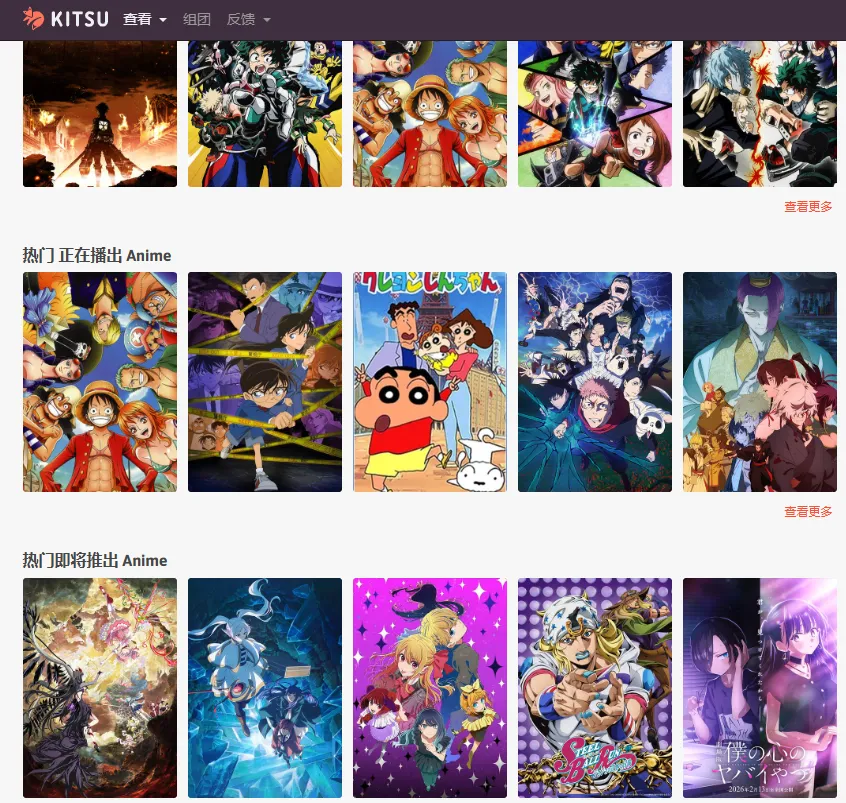
While its active user base is smaller than MyAnimeList’s, Kitsu remains a top choice for fans who prioritize a modern, mobile-optimized web experience. It is designed to be browsed like an Instagram feed, focusing on what’s trending and making it effortless to share your “reactions” to specific episodes. For users who want their tracking list to feel like a living social community rather than a static database, Kitsu offers a refreshing and user-friendly alternative.
| Pros | Cons |
| Polished Mobile Experience: Offers a fluid and visually consistent mobile-optimized website that feels like a native app | Small Community: Significantly lower volume of user reviews and active discussion threads than MAL. |
| Streaming Integration: Features a "where to watch" tool that links directly to official platforms like Netflix and Crunchyroll. | Database Gaps: Entry approvals for niche or very new titles can occasionally be slower than its competitors. |
| Unified Library: Excellent support for tracking Anime, Manga, Manhwa, and Light Novels in a single, cohesive interface. | Social Noise: The global activity feed can sometimes feel cluttered with non-anime related or low-quality content. |
| Reaction System: A modern feedback loop that allows users to post quick, image-based "reactions" to specific episodes. | Feature Parity: Certain advanced web-based management tools are often simplified or missing in the app version. |
| Intuitive UI: A colorful and modern aesthetic that is highly welcoming for newcomers to the anime tracking hobby. | Customization: Fewer profile personalization and advanced CSS styling options compared to AniList. |
4. AniDB: The Hardcore Technical Vault
Official Website:https://anidb.net/
APP Download:/
AniDB (Anime DataBase) is the ultimate sanctuary for data purists and technical collectors. Eschewing the social trends and sleek visuals of modern web design, AniDB focuses exclusively on data integrity, granular categorization, and the technical specifics of anime releases. It is unparalleled in its ability to track release groups, file versions (TV vs. Blu-ray vs. Director’s Cut), and complex staff relationships that most other sites overlook.
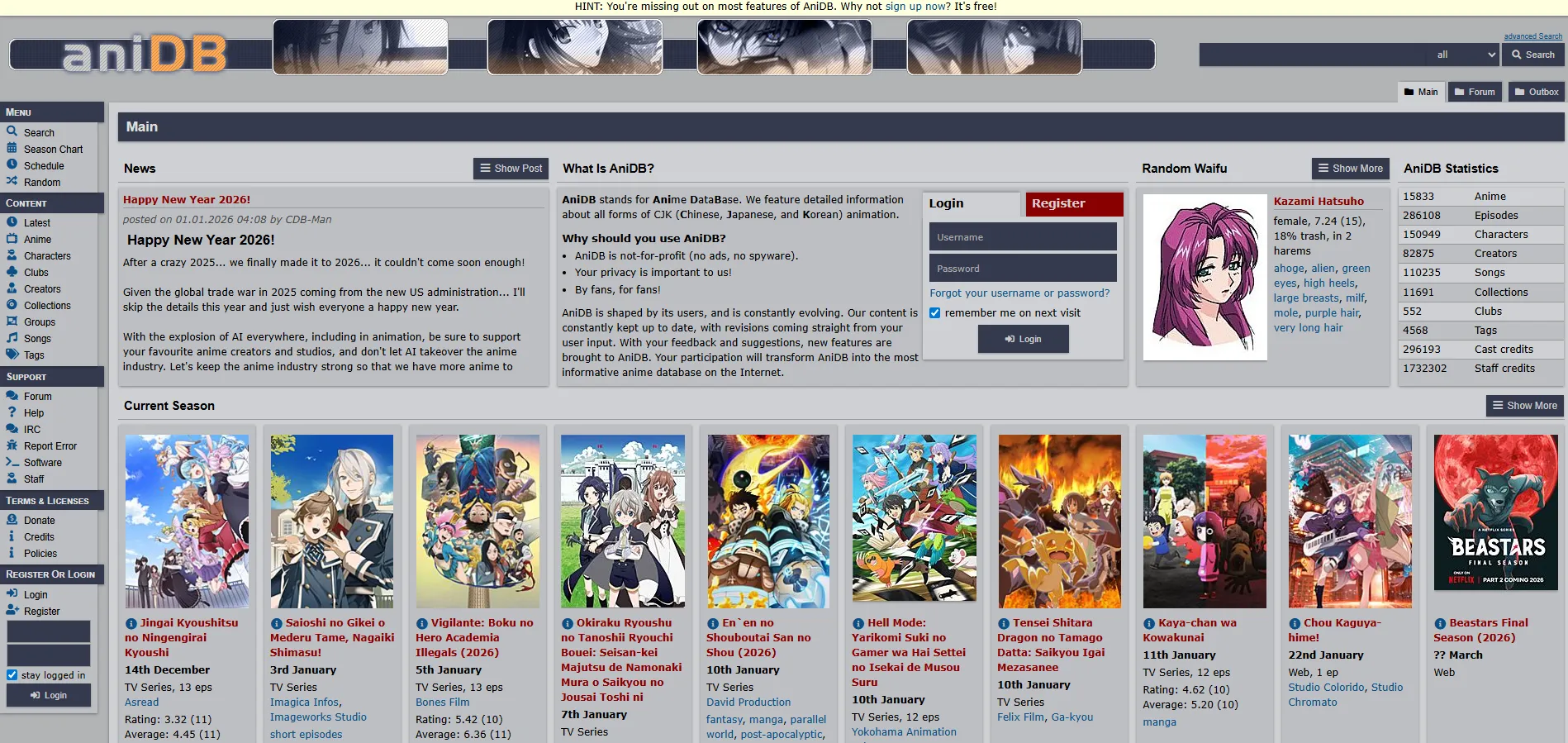
In 2026, while it may appear "stuck in time" to the casual viewer due to its early-2000s interface, it remains the most trusted source for archivalists and power users. Its weighted tagging system is the most sophisticated in existence, allowing for clinical precision when searching for specific tropes or themes. For those who demand technical accuracy above all else and treat their anime collection as a digital library, AniDB is an irreplaceable, albeit high-barrier, resource.
| Pros |
Cons |
| Unmatched Accuracy: The gold standard for tracking specific file versions, codecs, and release groups. | Severe Learning Curve: The technical nature of the site makes navigation extremely difficult for beginners. |
| Weighted Tagging: Features a massive, scientific tagging system that defines genres and themes with extreme precision. | Anime Only: Strictly focused on animated content; does not support Manga or Light Novel tracking. |
| No Commercial Bias: A community driven by technical merit and objective data rather than social hype or marketing. | Primitive Design: The interface is a relic of the early web era and is not optimized for mobile browsing. |
| Hierarchical Structure: Consolidates all seasons, OVAs, and movies of a franchise into a logical, master-entry system. | Social Void: Virtually no modern social features, activity feeds, or friend interaction tools available. |
| Archival Depth: Provides highly reliable historical data for obscure staff credits and industry connections. | High Friction: Requires significant manual effort to master the complex search filters and entry systems. |
The Great Four: Side-by-Side Comparison
While each platform has its own soul, the best choice often depends on your specific habits: are you a data-driven archivist or a social-first casual viewer? To help you cut through the noise, we’ve placed the "Big Four" in a direct showdown, comparing the technical features and community vibes that will define your daily tracking experience in 2026.
1. Core Features & Technical Showdown
The following matrix breaks down the "hard" technical capabilities of each platform, from database precision to the flexibility of their scoring systems.
Feature Comparison Matrix
| Feature |
MyAnimeList |
AniList |
Kitsu |
AniDB |
| Tracking Accuracy | Legacy Standard (Manual) | Seamless (Modern) | Visual-First | Clinical Precision |
| Scoring System | 1–10 (Strict) | 100-pt / Stars / Emoji | 1–5 Stars | 0–100 (Weighted) |
| Data Viz / Stats | Basic Bar Charts | Advanced Analytics | Social Feed Only | Technical Metadata |
| Search & Tags | Genre-based (Basic) | High-Density Tags | Discovery-centric | Scientific Tags |
| API & Automation | Jikan (Restricted) | Powerful GraphQL API | Good (Mobile-ready) | UDP (Technical/Hard) |
| Bulk Editing | ❌ | ✅ (Excellent) | ❌ | ✅ |
| 3rd-Party Support | Best (MAL-Sync) | Superior (Apps/Bots) | Moderate | Specialized (Taiga) |
Tracking & Management: AniList wins for "Quality of Life." Its bulk editing and modern UI make managing a 500+ title list effortless. MAL is better if you just want a simple, "no-fuss" list.
Data & Visualization: If you love looking at "Time Spent" pie charts or genre breakdowns, AniList is unrivaled. AniDB provides the best technical data (codecs, resolutions) for the "hoarders."
2. Community Experience & Discovery
Beyond the numbers, the "vibe" of a community determines how you interact with other fans and how easily you’ll find your next favorite series.
Ecosystem Comparison
| Aspect |
MyAnimeList |
AniList |
Kitsu |
AniDB |
| Discussion Type | Deep Forums (Threads) | Social Feed (Real-time) | Reactions (Fast) | Data Corrections |
| Vibe | Traditional / Critical | Modern / Inclusive | Casual / Young | Academic / Hardcore |
| Social Features | Clubs & Friends | Following & Feeds | Group Chats | None |
| Discovery Tools | "People also Liked" | Advanced Tag Search | Streaming Links | Version Tracking |
| Activity | Extremely High | High | Moderate | Low |
| AI Recommendation | User-based (Classic) | Trend-based (Hybrid) | Taste-matching AI | None |
| Mobile Access | Official App (Functional) | 3rd Party Apps (Elite) | Responsive Web | Desktop Only |
The Social Butterfly: AniList and Kitsu are the leaders. AniList’s feed feels like "Anime Twitter," while Kitsu’s integration with streaming platforms makes it the best for "watching and reacting" in the moment.
The Critic & Historian: MyAnimeList remains the king of long-form reviews. Its forums contain twenty years of history that modern feeds cannot replace. AniDB is the "Library of Alexandria" for pure technical facts.
Best Use Cases: Finding Your Perfect Match
After diving into the features and communities, the final question remains: which one is for you? In 2026, there is no single "best" platform, only the one that fits your lifestyle. Below are our tailored recommendations based on different user personas.
A. The Modern Collector: Recommend AniList
AniList is ideal for users who value a fast, modern interface and in-depth insights into their viewing habits. Features such as detailed statistics, visual breakdowns of time spent, and a highly customizable list system make it the strongest platform for structured tracking. Its open API and rich third-party ecosystem further solidify AniList as the gold standard for data-driven users in 2026.
B. The Social Butterfly: Recommend Kitsu (or AniList)
For users who treat anime tracking as a social activity, Kitsu offers the most social-first experience. Its activity feeds, reactions, and casual posting style encourage real-time interaction around episodes and seasonal shows. AniList can serve as a secondary option for users who want social features without sacrificing tracking depth.
C. The Traditional Archivist: Recommend MyAnimeList (MAL)
MyAnimeList remains the go-to platform for users who value stability, long-term records, and massive community consensus. Its straightforward list system, extensive reviews, and decades of accumulated user data make MAL the most reliable and familiar anime library for traditionalists.
D. The Technical Purist: Recommend AniDB
AniDB is designed for a niche audience that prioritizes data accuracy above all else. With its granular tagging system, release group tracking, and technical metadata, it caters to users who approach anime archiving with a professional or archival mindset. The learning curve is steep, but the depth is unmatched.
Final Pro-Tip:
In practice, many power users in 2026 don’t rely on just one platform. A common workflow is to use AniList for daily tracking—especially on mobile—while maintaining MyAnimeList as a long-term backup. Synchronization tools such as MAL-Sync make this multi-platform approach both practical and efficient.
Frequently Asked Questions (FAQ)
Q1: Can I move my data if I want to switch platforms?
A: Yes. All four platforms support (or have third-party tools for) XML/JSON exports. Most modern sites like AniList and Kitsu have an "Import" feature that allows you to upload your MyAnimeList .xml file directly. Your years of history won't be lost.
Q2: Which site has the best database for light novels and manga?
A: AniList and MyAnimeList are the winners here. While Kitsu has a beautiful interface for manga, MAL still holds the largest historical database for obscure older manga. AniDB, notably, does not support manga or light novels at all.
Q3: Is there a way to automate my tracking?
A: Absolutely. In 2026, tools like MAL-Sync (a browser extension) are essential. It detects what you are watching on Netflix, Crunchyroll, or Bilibili and automatically updates your list on MAL, AniList, or Kitsu.
Q4: Which platform is the "safest" from shutting down?
A: MyAnimeList is currently owned by a large Japanese corporate alliance (including Kadokawa and Kodansha), making it the most financially stable. AniList and Kitsu rely more on community donations and smaller investors, though they have remained stable for years.
Q5: Why are the scores different across these sites?
A: Because of the demographics. MAL reflects the "global consensus" but is prone to "review bombing." AniList users tend to favor modern, trending shows. AniDB scores are usually lower and more "critical" because they use a weighted system to filter out casual fan bias.
Q6: Which platform has the best community discussions?
MyAnimeList offers the largest and most active discussion forums, especially for seasonal anime and popular series. AniList’s community is smaller but more focused, with lightweight social interactions. Kitsu emphasizes casual conversation, while AniDB is largely community-light.
Q7: Which platform is best for long-term data preservation?
MyAnimeList and AniList are the safest options for long-term tracking due to their stability, large user bases, and export/sync support. AniDB is reliable for raw data accuracy but less friendly for casual long-term use.
Conclusion
Anime tracking platforms in 2026 serve very different purposes, from social interaction to deep data analysis. MyAnimeList, AniList, Kitsu, and AniDB each excel in their own areas, and none of them is universally “better” than the others. The right choice depends on how you track, discuss, and engage with anime. For many users, combining platforms offers the best experience. With more tools and integrations than ever, today’s anime fans have the flexibility to build a tracking setup that truly fits their needs.