
For many, Ghost in the Shell (1995) is the definitive cyberpunk masterpiece—a film that redefined sci-fi and paved the way for The Matrix. Yet, while it remains his most famous work, it is only one fragment of Mamoru Oshii’s strange and deeply influential universe. Over four decades, Oshii has blurred the lines between political thrillers, dystopian sci-fi, and surreal arthouse experiments. Whether he is deconstructing artificial intelligence or meditating on religious symbolism, his films share a singular DNA: a cold visual style, a haunting atmosphere, and a refusal to offer easy answers. In this guide, we rank the essential Mamoru Oshii filmography—from the iconic to the experimental—including where to stream them in 2026 and the best viewing paths for newcomers.
Mamoru Oshii Movie Universe at a Glance
Before diving into the full rankings, this quick-reference table provides a snapshot of Oshii’s vast filmography. Whether you are looking for the absolute essentials or the weirdest live-action experiments, here is how the "Oshii-verse" stands in 2026.
| Tier | Film | Year | Type / Themes | 2026 Viewing Recommendation |
| S | Ghost in the Shell | 1995 | Cyberpunk / Identity | Essential. The gold standard for sci-fi; 4K remasters are now widely available. |
| S | Patlabor 2: The Movie | 1993 | Political Thriller / War | Essential. A chillingly accurate prophecy of modern "invisible" warfare. |
| S | Angel's Egg | 1985 | Arthouse / Symbolism | Must-Watch. A visual masterpiece; 2025's 40th-anniversary restoration is a peak experience. |
| A | Ghost in the Shell 2: Innocence | 2004 | Baroque Cyberpunk | Recommended. A dense, visual feast for those who love deep philosophical inquiry. |
| A | Jin-Roh: The Wolf Brigade | 1999 | Political Allegory | Essential. Written by Oshii; the emotional and brutal peak of the Kerberos Saga. |
| A | Urusei Yatsura 2 | 1984 | Dream Loops / Surrealism | Recommended. The moment Oshii transformed from a director into an auteur. |
| A | The Sky Crawlers | 2008 | Existential War Drama | Recommended. Hauntingly relevant in our current era of AI and drone-led conflicts. |
| A | Patlabor: The Movie | 1989 | Industrial Sci-Fi / Crime | Great Entry Point. Perfectly balances high-concept sci-fi with a detective plot. |
| B | Avalon | 2001 | Live-Action / VR | Underrated Gem. A proto-metaverse film that feels more realistic today than in 2001. |
| B | The Red Spectacles | 1987 | Surreal Noir / Satire | Cult Classic. The weird, theatrical origin of the Kerberos Panzer Cop universe. |
| B | Talking Head | 1992 | Meta-Cinema / Theory | For Hardcore Fans. A surreal "whodunit" set inside a disappearing anime production. |
| B | StrayDog: Kerberos | 1991 | Dystopian Noir | Atmospheric. A slow-burn, live-action exploration of exile and urban decay. |
| C | Tachigui: Fast Food Grifters | 2006 | Mockumentary / Absurd | Niche. A bizarre, "paper-puppet" style history of Japanese fast food stands. |
| C | Tokyo Mukokuseki Shojo | 2015 | Live-Action / Violence | Experimental. A late-career fever dream about trauma and shifting realities. |
| C | Garm Wars: The Last Druid | 2014 | English Fantasy Sci-Fi | Visual Curiosity. Ambitious world-building, though narratively polarizing. |
| D | Dallos | 1983 | Early OVA / Rebellion | Historical. Notable as the first-ever OVA in anime history. |
| D | Urusei Yatsura: Only You | 1983 | Sci-Fi Rom-Com | Completionist. A glimpse of Oshii's style before he fully broke the mold. |
| D | Twilight Q (Time Knot) | 1987 | Mystery / Sci-Fi Short | Short & Strange. An experimental piece exploring time and disappearance. |
How to Explore the "Oshii-verse"
Oshii’s work can be intimidating, so we’ve designed four distinct paths depending on what you’re looking for:
The Cyberpunk Icon Path: If you loved The Matrix or Blade Runner, follow this line to see how Oshii explored the merger of man and machine.
-
Ghost in the Shell → Ghost in the Shell 2: Innocence → Avalon
The Political & Military Thriller Path: For those who prefer grounded military tactics, urban espionage, and political conspiracies.
-
Patlabor 1 & 2 → Jin-Roh → The Sky Crawlers
The Surrealist Arthouse Path: Best watched late at night. These films focus on dream logic, religious metaphors, and atmosphere over plot.
-
Urusei Yatsura 2: Beautiful Dreamer → Angel's Egg → Talking Head
The "Kerberos Saga" (The Dog Series): For hardcore fans who want to dive into Oshii’s lifelong obsession with armored soldiers and the loss of humanity.
-
The Red Spectacles → StrayDog → Jin-Roh
2026 Special Note: The Return of a Legend
As of late spring 2026, the Oshii experience is more accessible than ever. With the 30th-anniversary exhibition having toured Tokyo earlier this year and his new theatrical project, Armored Trooper VOTOMS: Die Graue Hexe, set for release on November 20, there has never been a better time to revisit his filmography.
Mamoru Oshii Movie Detailed Rankings: From Essential Icons to Existential Dreams
Having explored the broad landscape of Mamoru Oshii’s career, it’s time to look closer at the films that define his legacy. The following selection represents the "Core of Oshii"—the S-Tier and A-Tier works that are non-negotiable for anyone seeking to understand his vision. Each entry breaks down why these films matter and what specific philosophical "ghosts" they chase.
1. Ghost in the Shell (1995)
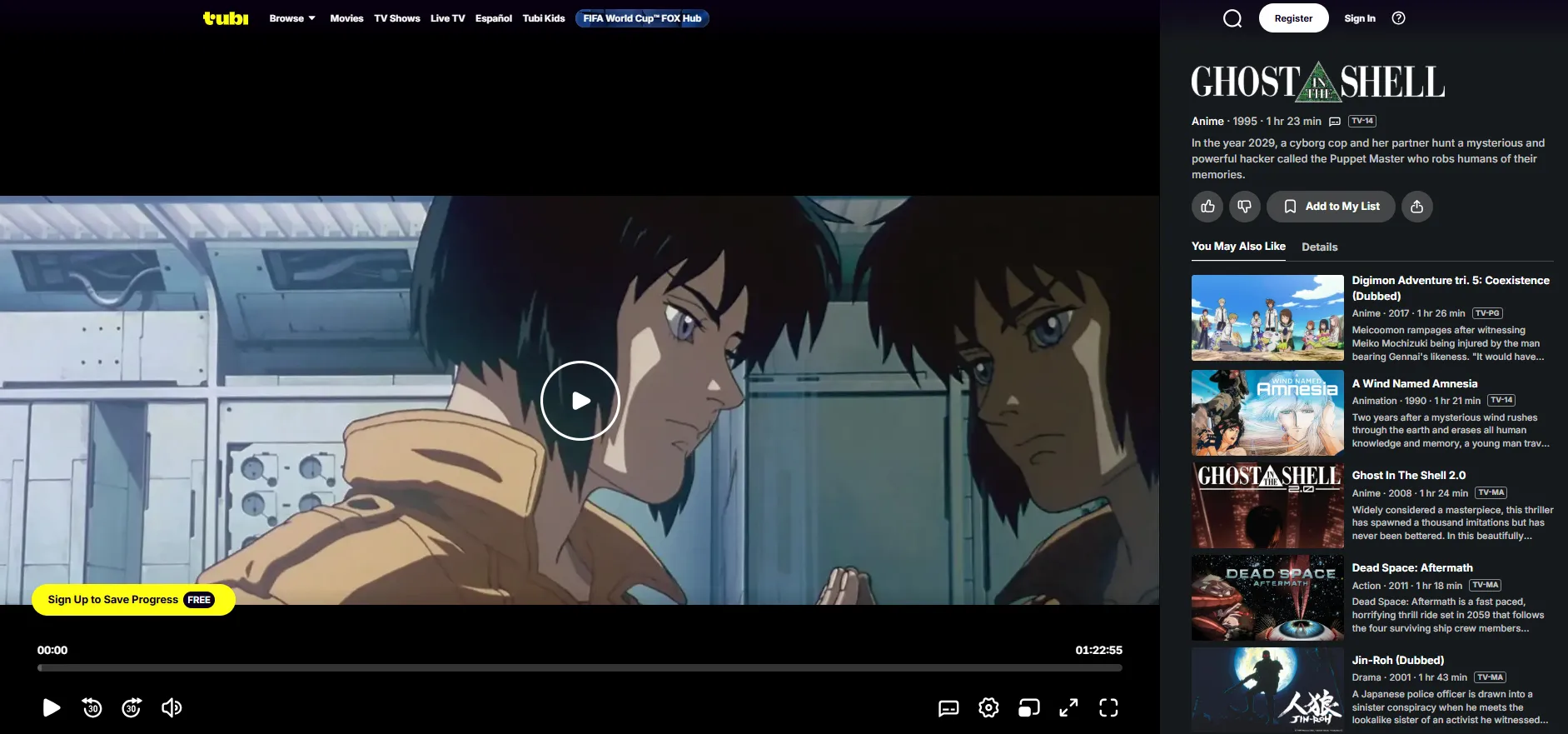
Where to streaming: Tubi
Few anime films have reshaped global science fiction as profoundly as Ghost in the Shell. Directed by Mamoru Oshii, the film transforms a cyberpunk police narrative into a deeply philosophical exploration of identity, consciousness, and the boundaries between human and machine.
Set in a near-future world dominated by cybernetic enhancement and digital networks, the story follows Major Motoko Kusanagi, an elite operative questioning her own existence as her body and mind become increasingly indistinguishable from artificial intelligence. What begins as a pursuit of a mysterious hacker known as the Puppet Master gradually evolves into a meditation on what it means to have a “self” in a world where memory and identity can be engineered.
Why It Matters
Ghost in the Shell is widely regarded as one of the most influential cyberpunk films ever made. Its impact extends far beyond anime, shaping Western science fiction cinema, including works such as The Matrix and numerous AI-centered narratives. It also marked a turning point in anime storytelling—proving that animation could carry slow, philosophical, and adult-oriented science fiction on a global scale.
Themes
-
Identity as a Construct: Rather than a fixed essence, identity is seen as a fluid collection of data.
-
The Ghost and the Shell: The fusion of human consciousness with artificial systems.
-
Urban Alienation: The hyper-technological society creates a cold, isolated landscape.
Best For
-
Cyberpunk and sci-fi fans
-
Viewers interested in AI and consciousness theory
-
Anyone exploring Oshii’s work for the first time
2. Patlabor 2: The Movie (1993)
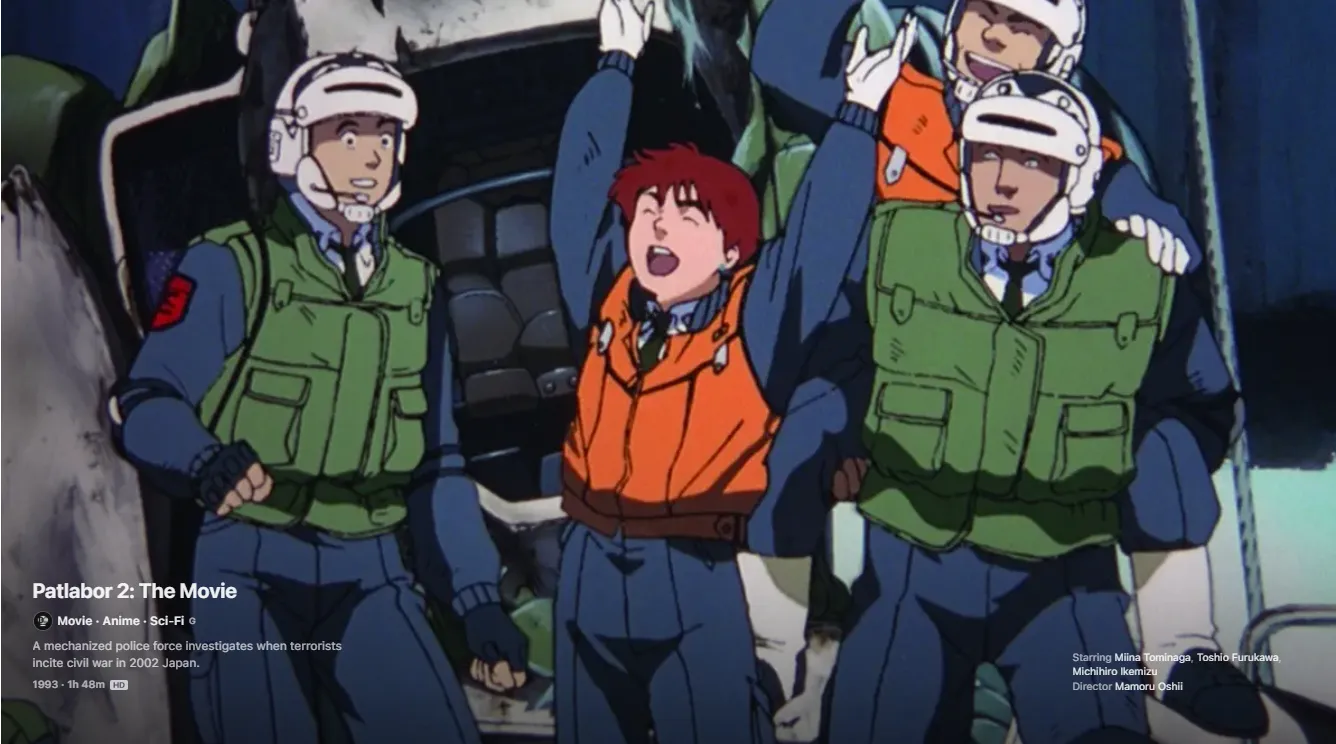
Where to streaming: Apple TV
While the Patlabor franchise is ostensibly about giant police robots, its second theatrical outing is a cold, clinical political thriller that barely features its titular machines. Directed by Oshii at the height of his atmospheric mastery, it remains one of the most sophisticated political films in animation history.
The story unfolds as a mysterious terrorist cell orchestrates a series of provocations in Tokyo, pushing the city toward martial law. What follows is not a traditional mecha battle, but a haunting chess match between a radical veteran and the cerebral Captain Goto, exploring the terrifying fragility of a modern city under information warfare.
Why It Matters
Patlabor 2 is a prophetic masterpiece that anticipated the nature of 21st-century conflict—cyber-attacks, media manipulation, and "invisible" warfare. It proved that anime could tackle complex geopolitics and domestic anxiety with more maturity than most live-action cinema.
Themes
-
The Illusion of Peace: A scathing critique of post-war Japan, questioning if a "just war" is better than a "hypocritical peace."
-
Structural Fragility: How easily a high-tech metropolis can collapse when its communication and digital trust are severed.
-
The Absence of God: Using military helicopters and snowy cityscapes to create a sense of divine, cold observation.
Best For
-
Fans of political thrillers and espionage (e.g., Tom Clancy, Tinker Tailor Soldier Spy)
-
Viewers who prefer slow-burn tension over action
-
Anyone interested in the intersection of military history and urban sociology
3. Angel’s Egg (1985)
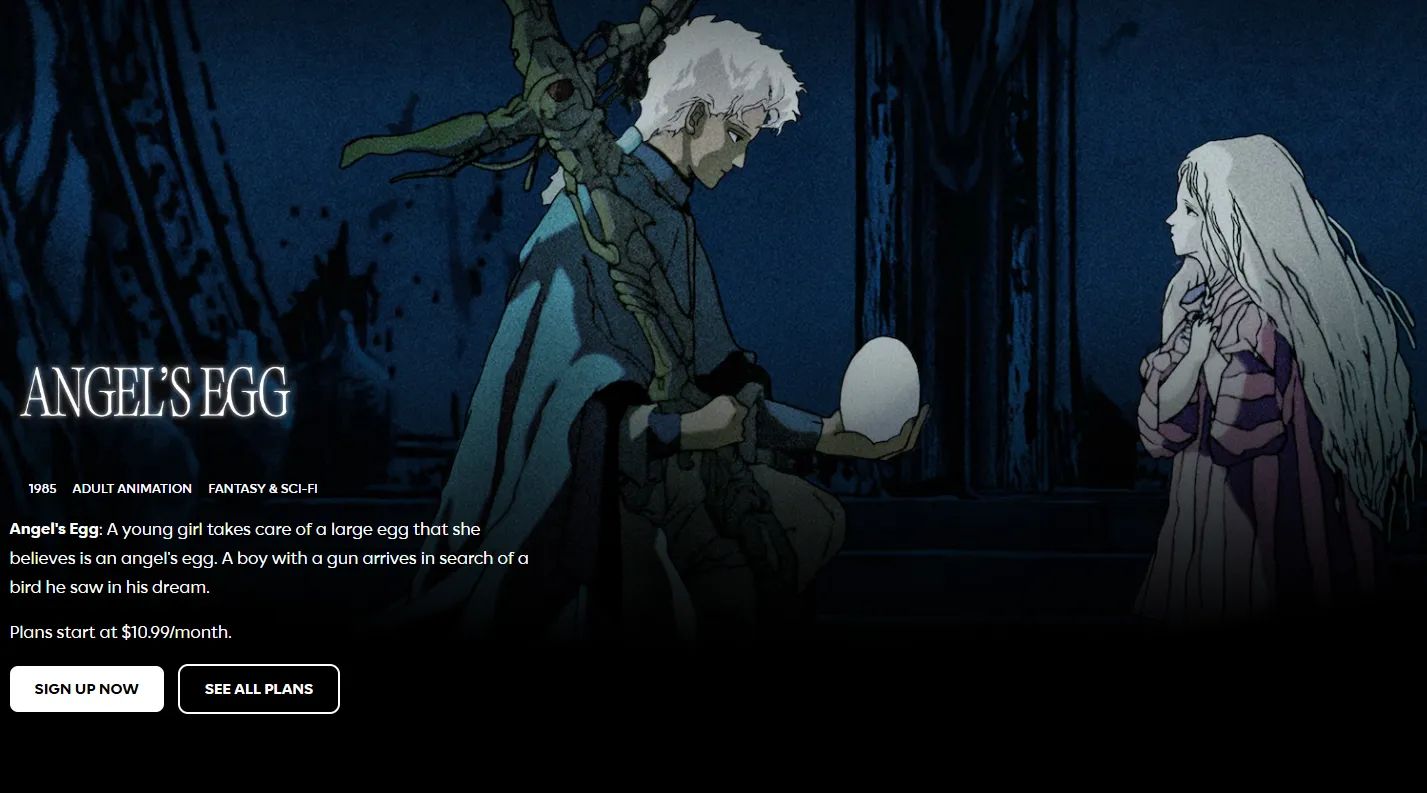
Where to streaming: HBO Max
A surrealist fever dream born from Oshii’s own spiritual crisis, Angel’s Egg is perhaps his most polarizing and artistically pure work. Collaborating with legendary artist Yoshitaka Amano, Oshii created a visual poem that defies traditional narrative logic entirely.
In a desolate, Gothic wasteland filled with fossilized shadows and mechanical fish, a young girl protects a large egg while a mysterious soldier carrying a cross-shaped weapon follows her. There is almost no dialogue; the film communicates through haunting shadows, dripping water, and heavy religious metaphors.
Why It Matters
It is the pinnacle of "arthouse anime." In 2026, with the 40th-anniversary 4K remaster, the film’s hand-drawn textures and apocalyptic beauty remain unmatched. It represents a director pouring his soul and his loss of faith into the celluloid.
Themes
-
Existential Doubt: The struggle to keep faith in a world that feels abandoned by its creator.
-
Shadows of Reality: Using fossilized remains and reflections to question if the world we see is merely a ghost of the past.
-
The Weight of Observation: Long, static shots that force the viewer to look inward rather than follow a plot.
Best For
-
Arthouse cinema lovers and fans of symbolic storytelling
-
Followers of Yoshitaka Amano’s art style
-
Viewers who enjoy "vibe-based" movies like Stalker or The Mirror
4. Ghost in the Shell 2: Innocence (2004)
Where to streaming: Apple TV
If the first film was about the birth of a soul, Innocence is a baroque, overwhelming meditation on the "shell" that remains. Following Batou—the Major’s former partner—the story investigates a series of gruesome murders committed by malfunctioning gynoids (female-model androids).
The film is famous for its dense philosophical citations, ranging from Confucius to Milton, and its stunning visual blend of 2D and 3D animation. It moves away from the gritty streets of the original into a world of haunted doll mansions and surreal parades.

Why It Matters
It was the first (and remains one of the few) anime films to compete for the Palme d'Or at the Cannes Film Festival. In 2026, its exploration of the ethics of robotics and the emotional bond between humans and non-human entities (including Batou’s beloved Bassett Hound) feels more relevant than ever.
Themes
-
The "Lonesome" Cyborg: The isolation of those who are neither fully human nor fully machine.
-
Doll Ethics: If a machine can mimic a soul perfectly, does it deserve the same rights as a human?
-
Baroque Visuals: An obsession with intricate, mechanical detail as a reflection of internal complexity.
Best For
-
Hardcore philosophy buffs and art students
-
Fans of high-end, experimental animation visuals
-
Anyone who loved Batou in the original film
5. Jin-Roh: The Wolf Brigade (1999)
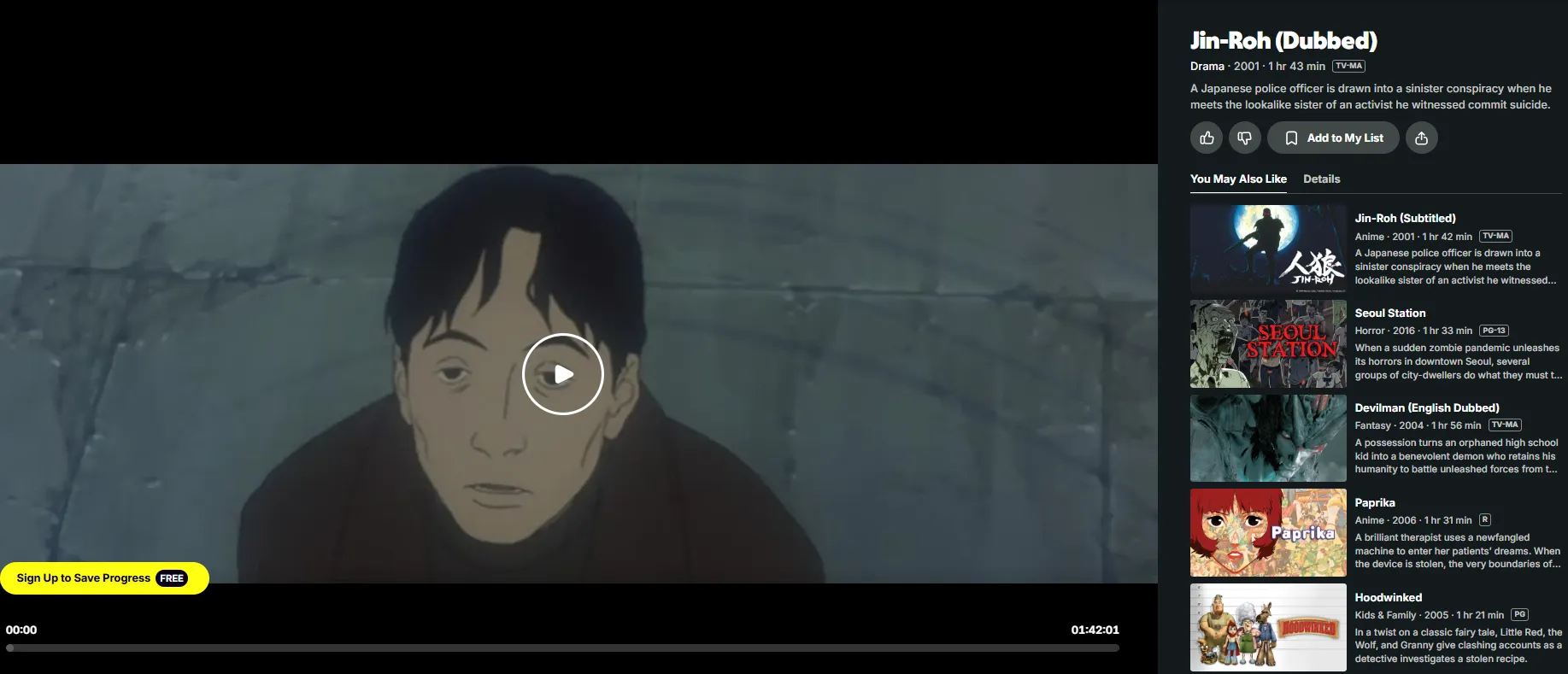
Where to streaming: Tubi
Though directed by Hiroyuki Okiura, Jin-Roh is the spiritual heart of Oshii’s "Kerberos Saga" (which he wrote and originated). It is a bleak, tragic subversion of the Little Red Riding Hood fairy tale set in an alternate-history 1950s Japan.
The film follows a member of an elite armored police unit who fails to stop a young female suicide bomber. Traumatized, he begins a relationship with the girl’s sister, only to find himself caught in a lethal conspiracy between rival government factions.
Why It Matters
It is a masterclass in realistic animation and melancholic storytelling. It strips away the sci-fi spectacle of Ghost in the Shell to tell a grounded, heartbreaking story about how collective systems strip humans of their humanity.
Themes
-
The Beast Within: The metaphor of the "wolf" in human clothing—can a professional killer ever truly love?
-
Governmental Deceit: The cold machinations of internal security forces and the expendability of individuals.
-
Visual Realism: Some of the most detailed hand-drawn urban environments and tactical movements ever animated.
Best For
-
Fans of tragic noir and gritty military drama
-
Viewers who appreciate highly detailed, realistic animation
-
Anyone interested in alternate history or the "Kerberos" universe
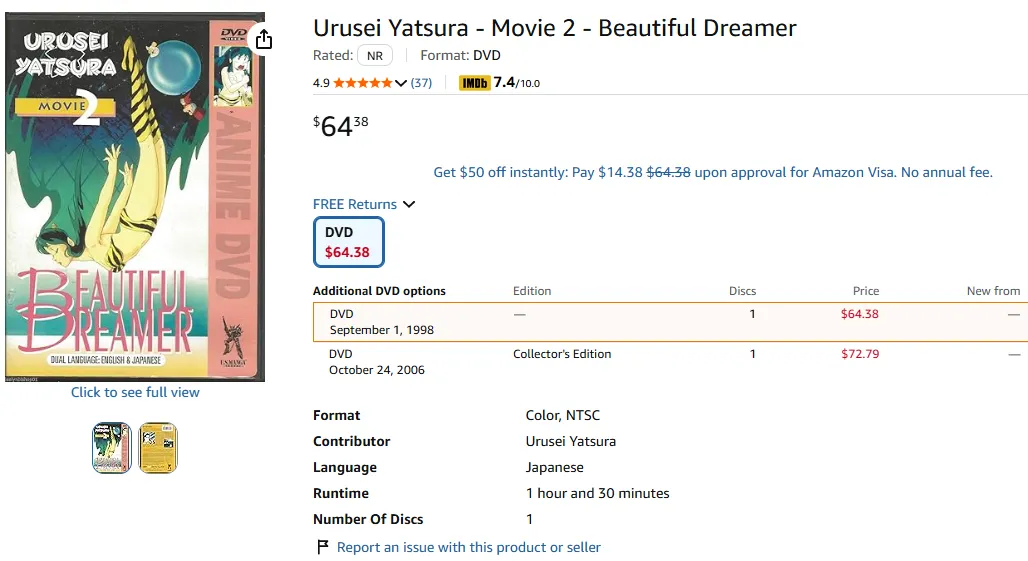
6. Urusei Yatsura 2: Beautiful Dreamer (1984)
Where to streaming: Amazon (DVD)
This was the pivotal moment Mamoru Oshii transformed from a reliable director-for-hire into a true "auteur." Taking a beloved, chaotic slapstick comedy franchise, Oshii staged a "cinematic coup," deconstructing the series into a surreal meditation on time loops and the comfort of endless dreams.
The story begins innocently: the students of Tomobiki High are frantically preparing for their school festival. However, they soon realize they are trapped, living the same day over and over. As the city of Tomobiki begins to vanish, leaving only the school floating in a void, the film shifts from a comedy into an existential mystery. It questions whether we prefer the safety of a beautiful, unchanging dream over the chaotic progression of real life.
Why It Matters
It is the spiritual ancestor of the "time loop" subgenre in anime, directly influencing masterpieces like The Melancholy of Haruhi Suzumiya ("Endless Eight") and even Western films like Inception. It proved that Oshii could inject profound existential dread into even the most mainstream, commercial properties—often to the shock of the original creator and fans.
Themes
-
The Infinite Loop: The terror and seduction of a world that never moves forward, preserving the "status quo" at the cost of reality.
-
Subjective Reality: The idea that the world exists only as long as someone is dreaming it, and the moral consequences of waking up.
-
Deconstruction of Comedy: Breaking the "fourth wall" of a sitcom to show the hollow void beneath the laughter.
Best For
-
Viewers interested in the origins of "Time Loop" and "Meta-fiction" tropes.
-
Fans who want to see the exact moment Oshii’s philosophical style was born.
-
Anyone who enjoys surrealist visuals mixed with 80s nostalgia.
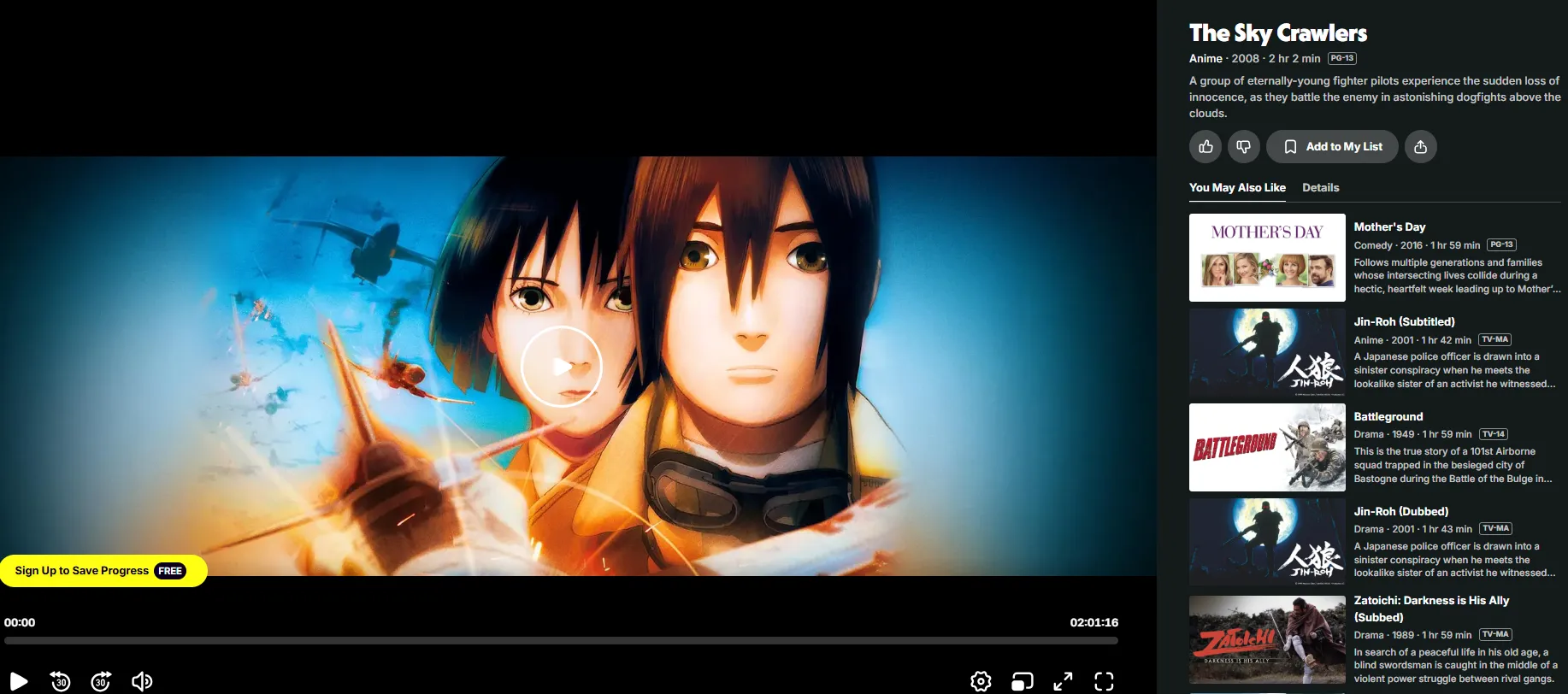
7. The Sky Crawlers (2008)
Where to streaming: Tubi
Oshii’s take on the "eternal youth" trope is a somber, meditative war film. Set in an alternate reality where war has been privatized and turned into a televised spectacle for a peaceful public, it follows a group of genetically engineered pilots called "Kildren" who never age.
The film focuses on the repetitive nature of their lives—flying missions, eating at diners, and waiting for a death that will only lead to them being replaced by another clone with the same face.
Why It Matters
It captures the "stagnant melancholy" of the modern generation. In 2026, its commentary on "staged conflicts" and drone-like warfare feels eerily prescient. It is a war movie where the battle for a soul is more important than the battle in the air.
Themes
-
Eternal Stagnation: The psychological horror of being stuck in an endless loop of youth and combat.
-
War as Spectacle: The idea that a peaceful society requires a "visible" but controlled conflict to maintain its stability.
-
Sensory Repetition: The mundane beauty of cigarettes, coffee, and mechanical maintenance.
Best For
-
Viewers who enjoy existentialist literature (e.g., Camus, Sartre)
-
Aviation enthusiasts who appreciate tactical realism
-
Those looking for a slow-burn mood piece about the meaning of life
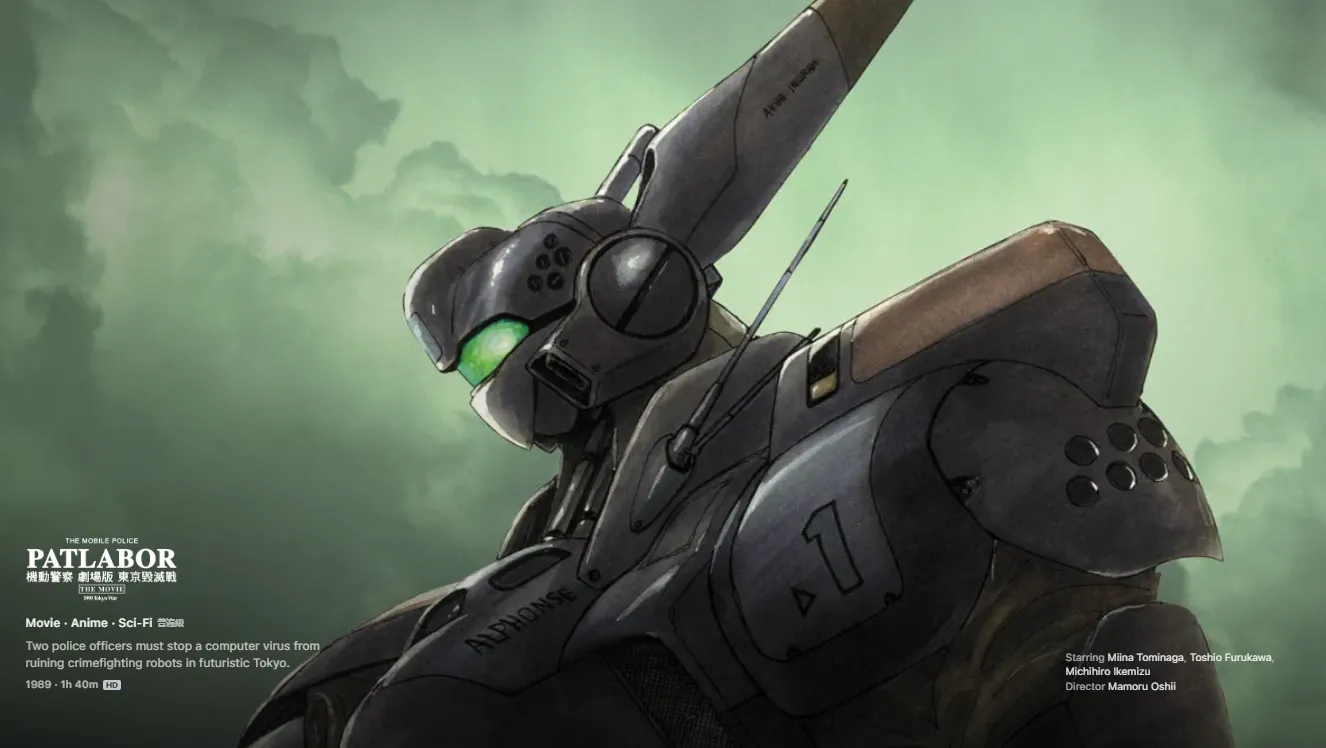
8. Patlabor: The Movie (1989)
Where to streaming: Apple TV
Before the heavy political dread of the sequel, the first Patlabor movie established Oshii as a master of the "high-tech detective" genre. The plot centers on a genius programmer who commits suicide, leaving behind a computer virus designed to make Tokyo's giant Labor robots go berserk during a massive hurricane.
It is a tighter, more action-oriented film than its successor, but it still carries the unmistakable Oshii DNA of urban mystery and technological skepticism.
Why It Matters
It serves as the perfect "bridge" between traditional 80s action anime and the philosophical depth Oshii would later become famous for. It remains one of the best examples of how to build tension using a ticking clock and environmental hazards.
Themes
-
The Ghost in the Machine: A precursor to GitS, exploring how a dead man's will can live on through code.
-
Old vs. New Tokyo: The conflict between the city’s rapid technological expansion and its decaying wooden past.
-
Systemic Fragility: The terrifying idea that a single line of malicious code can bring an entire society to its knees.
Best For
-
Newcomers who want a more accessible entry into Oshii’s work
-
Fans of police procedurals and "whodunit" mysteries
-
Those who enjoy 80s industrial sci-fi aesthetics
The "Oshii Flavour": Quick Picks for the Curious
For those who have survived the philosophical weight of the S-Tier and want to explore the stranger corners of Oshii’s mind, here is a rapid-fire guide. These films are the "side dishes"—sometimes salty, sometimes bitter, but always uniquely Oshii.
1. Avalon (2001)
Where to Watch: Amzon (DVD)
A live-action Polish-language cyberpunk odyssey. It feels like a sepia-toned precursor to the Metaverse, questioning reality in a world dominated by a lethal VR game.
2. The Red Spectacles (1987)
Where to Watch: Amzon (DVD)
A bizarre, surrealist stage-play on film. It marks the eccentric (and surprisingly comedic) birth of the Kerberos Saga.
3. Talking Head (1992)
Where to Watch: Youtube
A meta-cinematic mystery where characters spend the entire movie debating film theory while a murder goes unsolved. It is Oshii at his most "talkative."
4. StrayDog: Kerberos (1991)
Where to Watch: Amzon (DVD)
A slow-burn, atmospheric noir about exile and the loneliness of a soldier. Less action, more "Oshii-style" melancholic wandering.
5. Tachiguishi Retsuden (2006)
Where to Watch: Amzon (DVD)
A mockumentary about the philosophy of "fast-food grifters." Told entirely through a unique "paper-puppet" animation style. Extremely niche, extremely funny.
6. Tokyo Mukokuseki Shojo (2015)
Where to Watch: Amzon (DVD)
A slow-motion exploration of schoolgirl trauma that ends in a sudden, visceral 15-minute explosion of ultra-violence.
7. Garm Wars: The Last Druid (2014)
Where to Watch: Apple TV
A visually ambitious CGI fantasy. While the narrative is thin, it represents Oshii’s late-career obsession with blending digital landscapes and myth.
8. Dallos (1983)
Where to Watch: Crunchyroll
Crucial for historians as the world's first-ever OVA. You can see the seeds of his sci-fi rebellion growing here, even if the execution is raw.
9. Urusei Yatsura: Only You (1983)
Where to Watch: Crunchyroll
Oshii’s feature film debut; a chaotic interstellar wedding comedy that shows his early visual flair before he fully deconstructed the franchise in the sequel.
10. Twilight Q (1987)
Where to Watch: Internet Archive
A short, eerie mystery about disappearing objects and distorted time. A perfect "bite-sized" sample of Oshii’s fascination with the uncanny.
Frequently Asked Questions
1. What is Mamoru Oshii’s best movie?
This is still widely debated. Ghost in the Shell (1995) is his most internationally influential work and a defining cyberpunk classic. However, many critics argue that Patlabor 2: The Movie is his most structurally perfect political thriller, while Angel's Egg is often considered his most enigmatic and philosophically rich artistic statement.
2. Is Ghost in the Shell still worth watching in 2026?
Yes—more than ever. In the age of AI-generated content, deepfakes, and human–machine integration, Ghost in the Shell feels increasingly relevant. Its exploration of identity and consciousness now mirrors real-world technological debates, and modern 4K restorations further enhance its visual impact.
3. Are Mamoru Oshii films difficult to understand?
They can be dense, but not inaccessible. Oshii prioritizes atmosphere, symbolism, and philosophical dialogue over linear storytelling. Even if the political or metaphysical details are unclear at first, the emotional tone and visual storytelling remain intentional and rewarding.
4. What should beginners watch first?
A good starting point is Patlabor: The Movie for a grounded entry point, or Ghost in the Shell for his most iconic cyberpunk work. These two films best represent his dual style: procedural realism and philosophical sci-fi.
5. Is Angel’s Egg connected to Ghost in the Shell?
Not narratively, but thematically yes. Angel's Egg explores silence, faith, and existential decay, while Ghost in the Shell focuses on technology and identity. Together, they can be seen as two sides of Oshii’s central obsession: the nature of the soul.
6. Did Mamoru Oshii inspire The Matrix?
Yes. The Wachowskis have openly cited Ghost in the Shell as a major influence. Elements such as cybernetic interfaces (plugs), urban dystopia, and the philosophical questioning of reality were heavily inspired by Oshii’s vision.
7. What is the best order to watch Mamoru Oshii movies?
A recommended path is to start with accessible films (Patlabor 1, GitS), then move into deeper works (Patlabor 2, Innocence), and finally explore experimental films like Angel's Egg and Avalon.
8. Why are Mamoru Oshii movies so slow or boring?
The pacing is intentional. Oshii uses slow pacing, silence, and long static shots to emphasize contemplation and philosophical reflection rather than action-driven storytelling. The goal is meditation, not entertainment in the traditional sense.
9. How is Mamoru Oshii different from other anime directors?
Unlike most directors who focus on character-driven narratives, Oshii builds films around philosophical systems and political structures. His work often feels closer to European arthouse cinema (like Tarkovsky or Godard) than mainstream anime storytelling.
Final Thoughts: The Enduring World of Mamoru Oshii
Across four decades of work, Mamoru Oshii has built one of the most distinctive and philosophically consistent bodies of cinema in animation. From cyberpunk landmarks like Ghost in the Shell to political masterpieces such as Patlabor 2: The Movie and spiritual enigmas like Angel's Egg, his films continue to challenge what animation can express—and what audiences are willing to confront.
What makes Oshii’s filmography so enduring is not just its influence on global sci-fi, but its refusal to offer easy answers. His movies are slow, reflective, and often emotionally distant, yet they linger precisely because they treat questions of identity, consciousness, and reality as unresolved problems rather than narrative conclusions. In doing so, they invite repeated viewing, reinterpretation, and debate long after the credits roll.
In 2026, with AI, virtual identity, and digital consciousness becoming everyday realities, Oshii’s ideas feel less like speculative fiction and more like early philosophical sketches of the present. Rewatching his films today is not just an act of appreciation—it is a way of re-examining the world through a lens that was far ahead of its time.
Whether you start with cyberpunk classics, political thrillers, or experimental arthouse works, the journey through Oshii’s cinema is ultimately a journey into uncertainty itself—and that is exactly what makes it unforgettable.